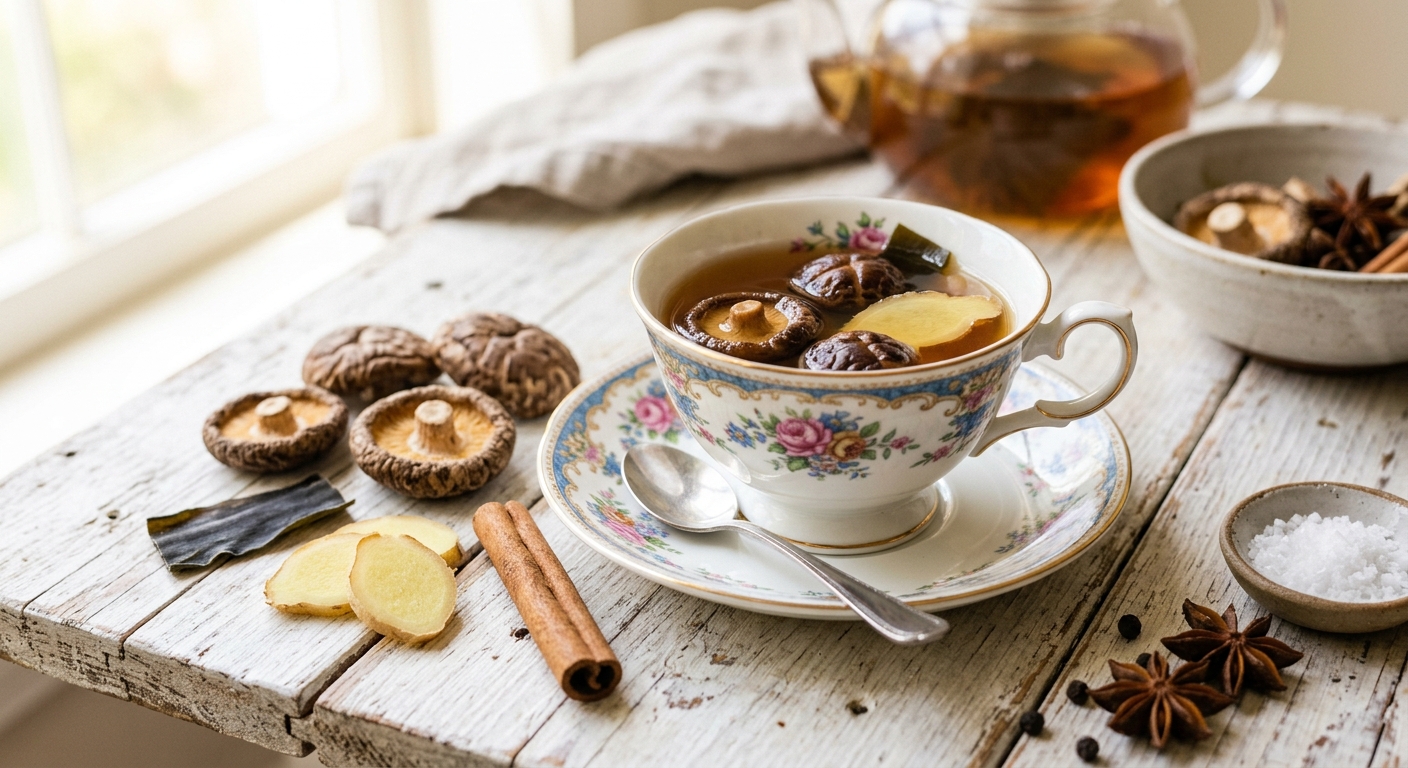
Long before shiitake mushrooms graced the plates of fine dining restaurants, they were revered across East Asia as a powerful medicinal food. In traditional Chinese medicine, shiitake has been used for over 6,000 years under the name xianggu, prescribed to strengthen the body’s vital energy, or qi, and to support longevity. Japanese herbalists similarly honored the mushroom as a symbol of health and resilience, and it became a staple of Taoist wellness traditions where food and medicine were considered inseparable.
What makes shiitake tea genuinely remarkable is that it captures the mushroom’s most potent bioactive compounds in a simple, drinkable form. Unlike cooking shiitake in a stir-fry, brewing a dedicated tea allows you to extract heat-stable beta-glucans, eritadenine, and lentinan at optimal concentrations. The result is a brew that is both nourishing and medicinal, with a rich, woodsy, umami depth that feels more like a warming broth than a typical herbal infusion.
Modern research has caught up with what traditional healers observed for millennia. Peer-reviewed studies have confirmed that shiitake’s polysaccharides actively modulate the immune system, support cardiovascular health, and exhibit antiviral properties. Whether you are brewing it as a daily wellness ritual, a cold-season shield, or simply to explore the world of functional mushroom teas, shiitake offers a deeply grounding and genuinely medicinal cup that stands apart from anything in the conventional tea aisle.
2
cups
Ingredients
- 4 piecesdried shiitake mushrooms (whole or sliced)
- 500 mlwater (90 to 95°C / 194 to 203°F)
- —1 small strip of kombu seaweed (optional, deepens umami)
- —thin slice of fresh ginger (optional, adds warmth)
- —few drops of tamari or a pinch of Colima Sea SaltMicroplastic Free Salt to taste (optional)
How to Brew
Click on an item below to shop for the recommended items for this recipe on Amazon.
As an Amazon Associate, we earn from qualifying purchases.
- Place 4 dried shiitake mushrooms (whole or broken into pieces) into a small saucepan or heat-resistant teapot. If the mushrooms are thick, break or slice them to increase surface area and improve extraction.
- Add 500 ml of water and bring it up to 90 to 95°C (194 to 203°F). Avoid a rolling boil, as excessive heat can begin to degrade some of the more delicate antioxidant compounds. Add a slice of fresh ginger or a strip of kombu at this stage if desired.
- Reduce heat to a gentle simmer and allow the mushrooms to steep for 20 to 30 minutes, keeping the pot partially covered to retain volatile aromatic compounds and prevent excessive evaporation.
- Remove from heat and allow the liquid to rest for 2 minutes. Strain the tea through a fine mesh strainer into your mug, pressing the softened mushrooms gently to release any remaining liquid.
- Taste the tea before adding anything. The natural umami is often satisfying on its own. If desired, add a few drops of tamari, a pinch of sea salt, or a thin slice of lemon to brighten the flavor. Sip slowly and enjoy the earthy warmth.
- Place 5 to 6 dried shiitake mushrooms (whole or lightly crushed) into a clean glass jar or pitcher. Using slightly more mushroom than the hot brew recipe compensates for the slower cold extraction rate.
- Pour 500 ml of cold, filtered water over the mushrooms. Do not use warm or hot water at any stage, as the goal is a slow, cold extraction that draws out polysaccharides with a gentler flavor profile.
- Seal the jar loosely with a lid or cover with a clean cloth. Allow the jar to sit at room temperature for 1 hour, then transfer it to the refrigerator.
- Let the mushrooms steep in the refrigerator for 10 to 14 hours, ideally overnight. The longer end of this range produces a deeper, richer extraction. Avoid steeping beyond 16 hours as the flavor can become overly mineral.
- Remove the jar from the refrigerator and strain the liquid through a fine mesh strainer into glasses filled with ice. The cold brew can be served chilled as-is or gently warmed on the stovetop if you prefer a warm cup. Garnish with a thin cucumber slice or a twist of lemon for a refreshing umami drink.
- Add 6 to 8 dried shiitake mushrooms to a medium saucepan along with 700 ml of cold, filtered water. Starting in cold water rather than hot water allows the cell walls of the mushroom to slowly open and release a broader spectrum of compounds as the temperature rises.
- Bring the water to a full boil over medium-high heat, then immediately reduce the heat to a low simmer. Place a lid slightly ajar over the pot to allow a small amount of steam to escape while retaining most of the liquid.
- Simmer gently for 40 to 60 minutes. The liquid will reduce significantly and darken to a deep mahogany color. Check periodically and top up with a small amount of hot water if the liquid reduces below 300 ml before the time is up.
- Remove from heat and allow to cool for 5 minutes with the lid fully on. Strain through a fine mesh strainer, pressing the mushrooms firmly to extract every drop of the concentrated liquid.
- The decoction will be intensely flavored and very concentrated. Dilute with 100 to 150 ml of hot water before drinking, or use the concentrate as a base for a mushroom broth by adding miso paste, scallions, or a soft-boiled egg. Sip in small amounts, 100 to 150 ml at a time, treating it as a tonic rather than a casual cup.
Health Benefits
Shiitake’s lentinan and other beta-glucans act as biological response modifiers, stimulating macrophages, dendritic cells, and natural killer cells. Multiple human trials have demonstrated that regular shiitake consumption measurably improves markers of immune competence, including increased secretory IgA levels.
Eritadenine has been shown in animal and in vitro studies to lower LDL cholesterol by interfering with its synthesis pathway. Shiitake also contains fiber, sterols, and antioxidants that collectively support healthy blood pressure and arterial function.
KS-2 glycoproteins and other polysaccharides in shiitake stimulate interferon production, a key antiviral signaling protein. Studies have also shown inhibitory effects against common bacterial pathogens including Staphylococcus aureus and Escherichia coli.
Quercetin and ergosterol work synergistically to reduce pro-inflammatory cytokine activity, making shiitake tea a useful daily tonic for those managing chronic low-grade inflammation associated with autoimmune conditions, metabolic syndrome, or intense physical training.
Shiitake tea delivers meaningful amounts of B2 (riboflavin), B3 (niacin), B5 (pantothenic acid), copper, selenium, and zinc in a highly bioavailable liquid form, supporting energy metabolism, thyroid function, and antioxidant enzyme activity.
🧪 Key Bioactive Compounds
The Science Behind Shiitake Mushroom
The immune-modulating power of shiitake mushroom tea is rooted primarily in its beta-glucan polysaccharides, with lentinan being the most studied. Lentinan is a high-molecular-weight 1,3-beta-D-glucan with 1,6-beta-D-glucoside branch points. When consumed, it interacts with pattern recognition receptors on immune cells, particularly Dectin-1 receptors on macrophages and dendritic cells. This interaction triggers a cascade that activates both the innate and adaptive immune systems, increasing production of cytokines like interleukin-12 and interferon-gamma. In Japan, a purified injectable form of lentinan has been approved as an adjunct cancer therapy since the 1980s, and several clinical trials have confirmed its ability to improve survival outcomes in gastric and colorectal cancer patients when used alongside chemotherapy.
Eritadenine, a unique adenosine-derived alkaloid found almost exclusively in shiitake among edible mushrooms, operates through a fundamentally different pathway. It inhibits S-adenosyl-L-homocysteine hydrolase, an enzyme involved in methyl group transfer reactions that play a role in cholesterol biosynthesis. Animal studies have consistently shown that eritadenine supplementation reduces plasma cholesterol levels, and researchers believe this mechanism may also have implications for homocysteine metabolism, a known cardiovascular risk factor. Ergosterol, meanwhile, serves as a precursor to Vitamin D2 and also independently inhibits angiogenesis, the process by which tumors develop new blood supplies, adding another dimension to shiitake’s potential protective effects.
The antioxidant and anti-inflammatory contributions of shiitake’s flavonoids, particularly quercetin and kaempferol, have been documented in multiple in vitro studies showing inhibition of nuclear factor-kappa B (NF-kB), a master regulator of the inflammatory response. By downregulating NF-kB signaling, these compounds reduce the production of pro-inflammatory prostaglandins and cytokines that drive chronic inflammation. Importantly, research has shown that water extraction methods, such as brewing shiitake as a tea, are highly effective at capturing the water-soluble beta-glucans and glycoproteins, meaning that a well-brewed cup delivers a genuinely meaningful therapeutic dose of these compounds rather than merely a symbolic trace.
Brewing Tips
- Always use dried shiitake rather than fresh for tea. The drying process concentrates the bioactive beta-glucans and intensifies the umami flavor, producing a far more medicinal and flavorful brew.
- Do not discard the spent mushrooms after brewing. The softened shiitake can be sliced and added to miso soup, ramen, or a simple stir-fry, giving you both a therapeutic tea and a nutritious ingredient in one preparation.
- For maximum immune benefit during cold and flu season, brew a large batch of shiitake decoction and store it in the refrigerator for up to 4 days. Reheat a small cup daily as a warming tonic, or add it as a broth base to soups and grains throughout the week.