Few discomforts are as distracting as a raw, scratchy throat. Whether it arrives with the first chill of autumn or follows a long night of restless sleep, throat pain has driven people to their herb gardens for thousands of years. Ancient Egyptians prepared slippery elm bark preparations for throat complaints, while Ayurvedic practitioners have long relied on ginger and honey as the cornerstones of respiratory care. Across cultures and centuries, the wisdom is remarkably consistent: nature offers some of the most effective and gentle remedies available for throat inflammation.
This blend centers on three powerhouse herbs chosen for their complementary actions. Licorice root provides glycyrrhizin, a compound with documented antiviral and anti-inflammatory properties that also creates a pleasant, soothing coating along the mucous membranes of the throat. Slippery elm bark releases a thick, gel-like mucilage when steeped in warm water, physically protecting raw tissue and calming the cough reflex. Fresh ginger brings heat and circulation to the area, while its gingerols inhibit inflammatory enzymes and provide mild antimicrobial activity. Together, they create a tea that works on multiple levels at once.
What makes this blend genuinely therapeutic rather than merely comforting is the synergy between coating, anti-inflammatory, and antimicrobial actions. A cup of plain hot water with honey will soothe temporarily, but this herbal preparation works on the underlying irritation while it soothes. It is warming and slightly spicy with a deep, sweet undertone from the licorice, and it fills the kitchen with a fragrance that feels medicinal in the best possible sense. Whether you are fighting a full cold or simply recovering from overusing your voice, this tea is one of the most practical remedies you can keep in your herbal cabinet.
2
cups
Ingredients
- 1 tspdried licorice root (cut and sifted)
- 1 tspslippery elm bark powder or cut bark
- 1 tspfresh ginger root, thinly sliced (or 0.5 tsp dried)
- 480 mlwater (95°C / 203°F)
- —raw honey to taste (optional but recommended)
- —a squeeze of fresh lemon juice (optional)
How to Brew
Click on an item below to shop for the recommended items for this recipe on Amazon.
As an Amazon Associate, we earn from qualifying purchases.
- Bring 480 ml of filtered water to 95°C (203°F). If you do not have a temperature-controlled kettle, bring water to a full boil and let it sit for 30 seconds before pouring.
- Add the licorice root and slippery elm bark directly to a small saucepan or a large heatproof mug. If using a mug, place a tea infuser or use a fine-mesh strainer at the end.
- Pour the hot water over the herbs and add the fresh ginger slices on top. Cover the mug or saucepan with a lid or small plate to trap volatile compounds and retain heat during steeping.
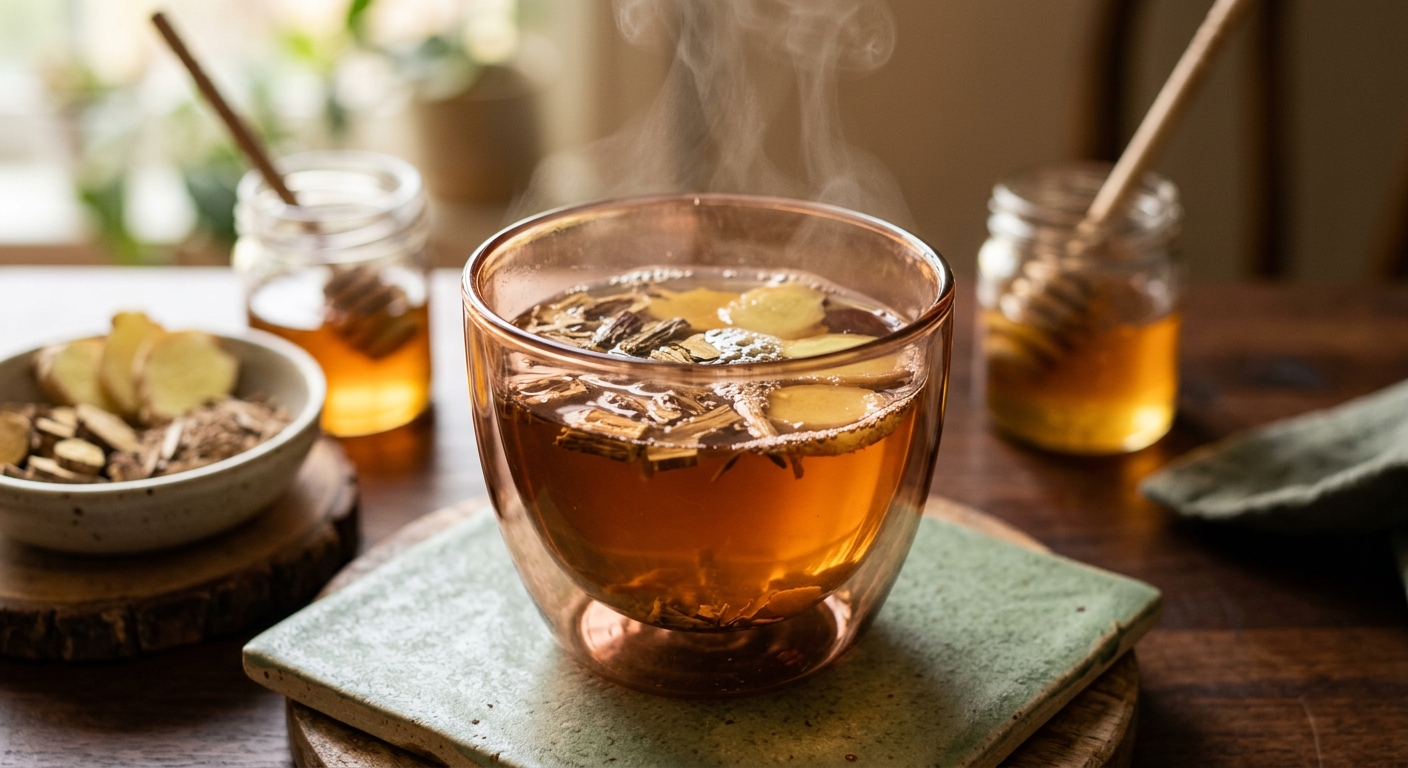
- Steep for 10 to 15 minutes. For maximum mucilage release from the slippery elm, go the full 15 minutes. The liquid will thicken slightly and take on a rich amber color.
- Strain the tea through a fine-mesh strainer into your mug, pressing the herbs gently with a spoon to extract remaining liquid.
- Stir in raw honey while the tea is still hot so it dissolves fully. Add a squeeze of lemon if desired. Sip slowly, allowing the tea to coat your throat as it goes down.
- Measure 1 tsp dried licorice root, 1 tsp slippery elm bark, and 0.5 tsp dried ginger into a clean glass jar. Because this is a cold extraction, dried ginger is preferred over fresh for a cleaner infusion.
- Pour 480 ml of cold, filtered water directly over the herbs. Do not use hot water. Stir gently to ensure the slippery elm powder is moistened and not floating on top.
- Seal the jar with a lid and let it sit at room temperature for 1 hour to allow the mucilage to begin releasing, then transfer to the refrigerator.
- Refrigerate for a full 8 to 12 hours, or overnight. The liquid will become noticeably thicker and more viscous than a hot brew, and will take on a pale amber tone.
- Strain through a fine-mesh strainer or cheesecloth, pressing the herbs firmly to extract the gel-like mucilage. The resulting liquid may feel slightly slippery on the palate – this is the therapeutic mucilage at work.
- Serve at room temperature or gently warm a single portion to a comfortable drinking temperature (not above 60°C / 140°F) to preserve the mucilage structure. Stir in honey just before drinking.
- Combine 2 tsp dried licorice root and 1 tsp slippery elm bark in a small saucepan with 600 ml of cold, filtered water. Starting in cold water allows the hard plant material to soften and release compounds gradually as the temperature rises.
- Place the saucepan over medium heat and bring to a very gentle simmer, around 85 to 90°C (185 to 194°F). You should see small, lazy bubbles rising from the bottom, not a rolling boil. A full boil will degrade some of the beneficial compounds.
- Add fresh ginger slices once the water reaches a simmer. Maintain the gentle simmer for 20 to 25 minutes, stirring occasionally. The liquid will reduce and deepen in color to a rich amber-brown.
- Remove from heat, cover the saucepan, and allow the decoction to rest for 5 additional minutes off the heat. This final rest allows volatile aromatic compounds from the ginger to settle back into the liquid.
- Strain through a fine-mesh strainer into a mug or heatproof pitcher, pressing the herbs well. You should yield approximately 400 ml of concentrated, deeply flavored tea.
- Add raw honey and lemon to taste. For a medicinal-strength preparation, drink one full mug three times per day during acute throat pain. Store any remaining decoction in the refrigerator for up to 24 hours and gently reheat before serving.
Health Benefits
Slippery elm’s mucilage forms a physical protective layer over raw mucous membranes, reducing friction from swallowing and coughing. This mechanical protection is one of the few herb benefits that does not require systemic absorption, making its effect both immediate and well-supported by traditional use and in vitro evidence.
Glycyrrhizin from licorice root has been shown in clinical and laboratory studies to inhibit pro-inflammatory enzymes including COX-2 and phospholipase A2, reducing the swelling and redness that cause pain. A 2019 study found licorice root gargle preparations comparable to ketamine gargles in reducing post-operative sore throat intensity.
Both licorice root and ginger have demonstrated activity against common throat pathogens. Glycyrrhizin has shown antiviral effects against influenza, herpes simplex, and respiratory syncytial virus in laboratory settings. Gingerols and shogaols exhibit antibacterial properties against Streptococcus mutans and other organisms associated with throat infections.
Shogaols in ginger have demonstrated antitussive effects in animal models by acting on cough-triggering receptors in the airway. Combined with the mechanical suppression of the cough reflex from slippery elm mucilage, this blend addresses the cycle of coughing that perpetuates throat irritation and tissue damage.
Ginger stimulates circulation and has been shown in clinical trials to reduce the severity and duration of upper respiratory infections. Its warming, diaphoretic properties support the body’s natural fever response, while its antioxidant compounds protect immune cells from oxidative stress during active infection.
🧪 Key Bioactive Compounds
The Science Behind Licorice Root
The therapeutic value of this blend rests on a foundation of well-characterized bioactive compounds working through distinct but complementary mechanisms. Glycyrrhizin, the primary active compound in licorice root (Glycyrrhiza glabra), has been the subject of hundreds of peer-reviewed studies since the mid-20th century. Its anti-inflammatory action operates through inhibition of phospholipase A2 and cyclooxygenase enzymes, the same pathways targeted by many non-steroidal anti-inflammatory drugs, but with a notably gentler side effect profile at typical herbal doses. Glycyrrhizin is also metabolized by gut bacteria into 18-beta-glycyrrhetinic acid, which has independent anti-inflammatory and mild cortisol-potentiating effects that help regulate the immune response during infection.
Slippery elm bark (Ulmus rubra) operates on an entirely different principle. Its high-molecular-weight polysaccharides, primarily arabinogalactans and rhamnose-containing polymers, absorb water and form a viscous gel. This mucilage is not absorbed into the bloodstream but acts locally along the entire length of the digestive and respiratory tract it contacts. The gel creates a physical barrier over exposed nerve endings and irritated epithelial cells, reducing the pain signals triggered by swallowing, talking, and coughing. This mechanism is often described as demulcent activity, and slippery elm is considered one of the most effective demulcent herbs in Western botanical medicine. Crucially, cold water extracts mucilage from slippery elm very efficiently, which is why the cold brew method in this guide produces a particularly thick and soothing preparation.
Ginger (Zingiber officinale) contributes to this blend as both a bioactive agent and a bioavailability enhancer. Its phenolic compounds, primarily gingerols in fresh ginger and shogaols in dried or heated ginger, have been shown to inhibit NF-kB signaling, a master regulatory pathway that controls the production of inflammatory cytokines such as interleukin-1 beta and tumor necrosis factor alpha. These are the same cytokines responsible for the swelling, redness, and pain of an infected or irritated throat. A 2015 randomized controlled trial published in the Journal of Ethnopharmacology found that ginger supplementation significantly reduced markers of upper respiratory inflammation compared to placebo. Additionally, ginger’s piperine-like compounds enhance the absorption of several co-administered phytonutrients, meaning it may amplify the systemic uptake of licorice root compounds when the two are brewed together.
Brewing Tips
- Use cut and sifted licorice root rather than whole sticks for hot brew and decoction. The greater surface area dramatically improves compound extraction in a reasonable brew time. Save whole licorice sticks for stirring honey into finished tea.
- If slippery elm powder clumps when you add water, whisk it briskly with a fork before sealing the jar or covering the cup. Starting with a small amount of warm (not hot) water to form a paste before adding the rest of the liquid also prevents clumping.
- Brew a double or triple batch of the decoction at the start of a cold, store it in a sealed glass jar in the refrigerator, and gently reheat individual portions throughout the day. Multiple doses across the day are more effective than one large cup, as the mucilage and anti-inflammatory compounds are cleared relatively quickly.