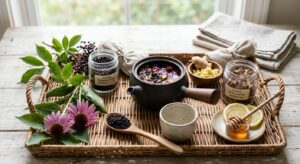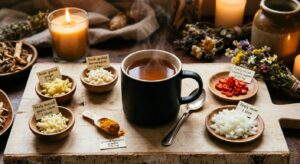
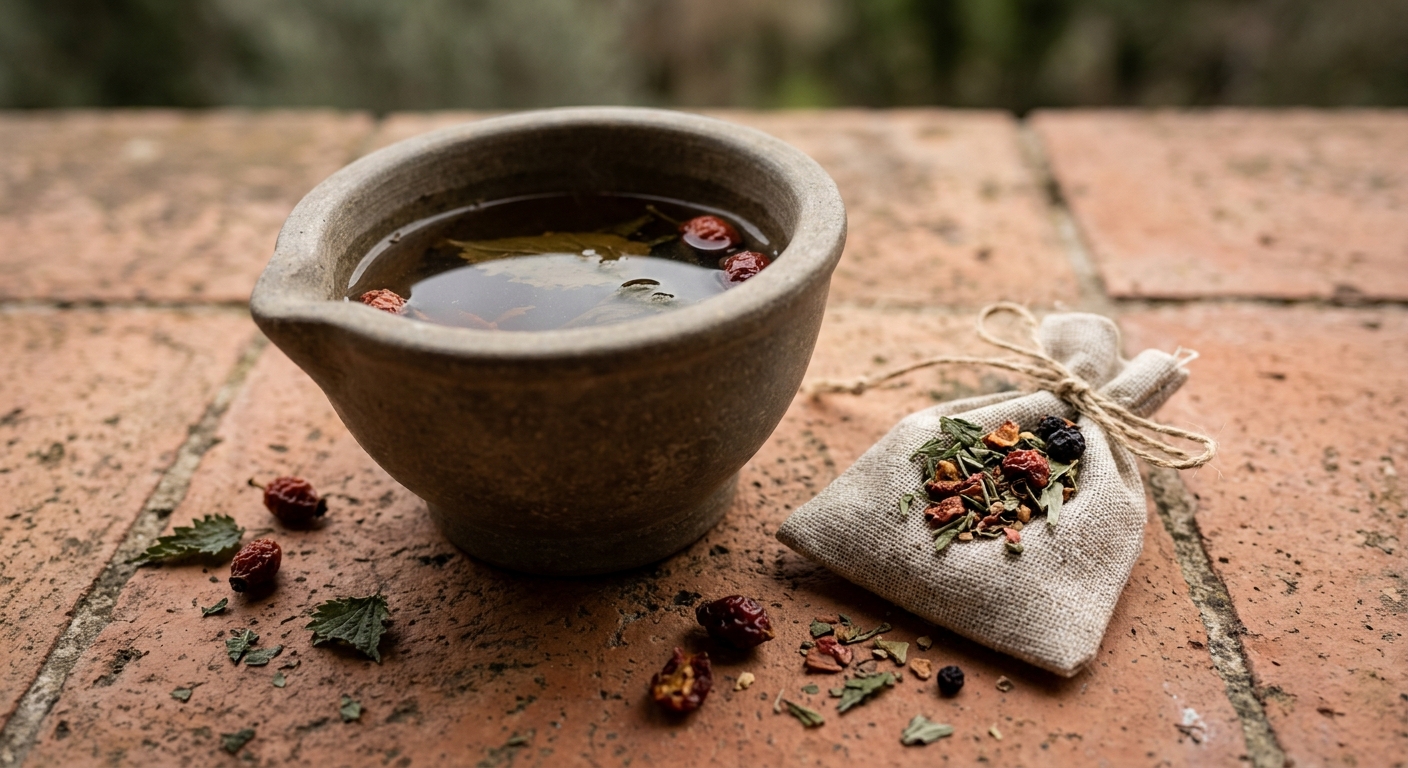
Zinc is one of the most critical minerals for immune function, wound healing, and cellular repair, yet it remains one of the most commonly deficient nutrients in the modern diet. Rather than reaching for a supplement bottle, generations of traditional herbalists across Europe, Asia, and the Americas have turned to mineral-rich plants as a steady, bioavailable source of zinc and the cofactors needed to put it to work. Nettle leaf, rose hip, and holy basil form the backbone of this blend, each contributing not just zinc but a constellation of vitamins, antioxidants, and adaptogens that create the conditions for optimal immune resilience.
Stinging nettle (Urtica dioica) has been used since ancient Roman times as a tonic herb, valued for its extraordinary mineral density. Medieval European herbalists prescribed nettle infusions for everything from fatigue to seasonal illness, recognizing that the plant’s dark green leaves were a storehouse of iron, calcium, magnesium, and zinc. Rose hip (Rosa canina), the fruit left behind after the rose blooms, became famous during World War II when British authorities organized nationwide harvests to replace vitamin C lost from citrus imports. Its partnership with zinc is significant because vitamin C enhances zinc absorption and the two compounds work synergistically to support the production and activation of immune cells. Holy basil (Ocimum tenuiflorum), revered in Ayurvedic medicine as Tulsi or the Queen of Herbs, rounds out the blend with adaptogenic compounds that modulate the stress response, since chronic stress is one of the fastest ways to deplete zinc reserves in the body.
The result is a tea that tastes grounding and gently herbaceous, with a pleasant tartness from the rose hips and a warm, clove-like undertone from the holy basil. It is a cup designed not just for moments of illness but for the kind of steady, daily nourishment that keeps the immune system alert and ready. Whether you brew it hot on a winter morning or cold-steep it overnight for a bright, mineral-rich afternoon drink, this blend rewards consistency and intention.
2
cups
Ingredients
- 2 tspdried nettle leaf
- 1 tspdried rose hips (whole or crushed)
- 1 tspdried holy basil (tulsi) leaf
- 0.5 tspdried elderberry (optional, for added zinc and antioxidants)
- 500 mlwater (95°C / 203°F)
- —raw honey to taste (optional)
- —a squeeze of fresh lemon juice (optional, to boost vitamin C and zinc absorption)
How to Brew
Click on an item below to shop for the recommended items for this recipe on Amazon.
As an Amazon Associate, we earn from qualifying purchases.
- Bring filtered water to 95°C (203°F). If using a standard kettle without temperature control, bring water to a full boil and allow it to rest for 30 to 60 seconds before pouring.
- Combine the dried nettle leaf, crushed rose hips, holy basil, and optional elderberry in a large tea infuser, strainer basket, or French press. Lightly crush the rose hips between your fingers before adding them to the infuser to break the skin and release their minerals more effectively.
- Place the infuser in a pre-warmed mug or teapot. Pour 500 ml of hot water directly over the herbs and cover the vessel immediately with a lid or small plate. Covering the tea traps volatile aromatic compounds from the holy basil that would otherwise escape as steam.
- Steep for 10 to 15 minutes. The longer end of this range produces a more minerally rich, deeply colored brew. Taste at the 10-minute mark and continue steeping if you prefer a stronger cup.
- Remove the infuser and gently press the herbs against the strainer to extract any remaining liquid. Add a squeeze of fresh lemon juice and raw honey if desired. Serve immediately while hot.
- Add the dried nettle leaf, crushed rose hips, holy basil, and optional elderberry directly to a clean glass jar or cold brew pitcher. For cold brew, increase the herb quantity by 25 percent, using approximately 2.5 tsp nettle, 1.5 tsp rose hips, and 1.5 tsp holy basil per 500 ml of water, to compensate for the lower extraction rate without heat.
- Pour room temperature filtered water over the herbs. Stir gently with a long spoon to ensure all plant material is fully submerged. Do not use hot water at any point, as heat is deliberately excluded in this method.
- Seal the jar with a lid and place it in the refrigerator. Allow the herbs to steep for 10 to 14 hours. Overnight is ideal. The cold and slow extraction preserves delicate aromatic compounds from the holy basil while drawing out minerals from the nettle and rose hips over time.
- When ready, strain the liquid through a fine mesh strainer or cheesecloth into a clean jar or serving glass, pressing the herbs gently to extract all liquid. Discard the spent herbs.
- Serve over ice with a slice of lemon or a drizzle of honey dissolved in a small amount of warm water before adding to the cold brew. This tea keeps refrigerated for up to 48 hours.
- Choose a clear glass jar with a tight-fitting lid. Place the dried nettle, crushed rose hips, holy basil, and optional elderberry inside the jar. As with cold brew, increase herb quantities by approximately 25 percent to ensure adequate extraction at low solar temperatures.
- Fill the jar with fresh, cold filtered water and secure the lid tightly. Give the jar a gentle shake to wet all the herbs evenly and help them begin releasing their compounds.
- Place the sealed jar in a spot that receives uninterrupted direct sunlight for the duration of the steep, ideally on a south-facing windowsill, patio, or garden surface. Allow the sun to infuse the herbs for 3 to 5 hours. The tea is ready when it has turned a warm amber-red color and the aroma is clearly fragrant when you open the lid.
- Bring the jar indoors and strain the tea through a fine mesh strainer into a serving pitcher or glasses. Press the herbs to extract remaining liquid.
- Add fresh lemon juice and honey to taste. Serve immediately over ice or at room temperature. Do not store sun tea for more than a few hours, as the warm brewing temperatures can encourage bacterial growth if left too long.
Health Benefits
Zinc is essential for the maturation of T-lymphocytes in the thymus gland and for the activation of natural killer cells that respond to viral infections. Clinical studies consistently link zinc deficiency with impaired immune function, and restoring adequate zinc levels through diet and plant sources rapidly improves immune responsiveness.
Vitamin C from rose hips and quercetin from nettle leaf work synergistically to improve how much zinc your body actually absorbs and transports into cells. Quercetin functions as a zinc ionophore, a molecule that shuttles zinc ions through cell membranes, while vitamin C reduces zinc oxidation in the gut to keep it in its more absorbable ionic form.
Meta-analyses of randomized controlled trials have found that adequate zinc intake, initiated within 24 hours of symptom onset, can reduce the duration of common cold symptoms by up to 33 percent. Rose hip’s vitamin C content adds complementary support, with research suggesting regular intake modestly reduces cold frequency in physically active people.
Holy basil’s adaptogenic compounds, including ursolic acid and rosmarinic acid, help regulate cortisol levels. Since chronic psychological stress rapidly depletes zinc stores and suppresses immune function, including an adaptogen in this blend addresses one of the most overlooked root causes of immune vulnerability.
The combination of quercetin, eugenol, and ursolic acid across these three herbs creates a broad anti-inflammatory environment that helps prevent the excessive immune activation, sometimes called a cytokine storm, that makes illnesses feel more severe. These compounds work through multiple pathways, including inhibition of NF-kB signaling, a master regulator of inflammatory gene expression.
🧪 Key Bioactive Compounds
The Science Behind Nettle Leaf
The zinc-supporting properties of this herbal blend operate through two distinct mechanisms: direct mineral contribution and enhanced bioavailability. Nettle leaf (Urtica dioica) is one of the most zinc-dense leafy plants documented in ethnobotanical literature, with dried nettle containing measurable concentrations of zinc alongside iron, calcium, and magnesium. But the quantity of zinc in any plant food is only part of the story. Zinc absorption in the human gut is notoriously variable, ranging from as low as 15 percent to over 40 percent depending on what else is consumed alongside it. This is where the quercetin content of nettle leaf becomes particularly significant. Research published in the Journal of Agricultural and Food Chemistry has demonstrated that quercetin acts as a zinc ionophore, forming a complex with zinc ions that facilitates their transport across lipid bilayer cell membranes. Once inside the cell, zinc can inhibit RNA-dependent RNA polymerase, an enzyme essential for viral replication, which may partly explain why zinc-rich interventions consistently shorten cold duration in clinical trials.
Rose hip’s extraordinary vitamin C content, with some varieties containing up to 50 times more vitamin C per gram than oranges, provides a second layer of absorption support. Vitamin C reduces zinc from its oxidized ionic state to the more bioavailable reduced form and maintains the acidic gut environment that favors zinc uptake. Beyond its role as a zinc cofactor, vitamin C is independently critical for immunity: it stimulates the production of lymphocytes and phagocytes, enhances the skin barrier’s function as a first line of defense, and accelerates the clearance of pathogens by boosting neutrophil motility. A landmark 2017 meta-analysis in Nutrients confirmed that regular vitamin C supplementation reduces cold duration in adults by approximately 8 percent, with higher reductions seen in individuals under physical stress.
Holy basil contributes to the science of this blend through its adaptogenic and anti-inflammatory compounds rather than direct zinc content. The herb’s primary bioactive compounds, including eugenol, rosmarinic acid, ursolic acid, and ocimumosides A and B, collectively modulate the hypothalamic-pituitary-adrenal (HPA) axis, the body’s central stress regulation system. Cortisol, the primary stress hormone produced by this axis under chronic activation, is a well-documented immunosuppressant that directly reduces zinc absorption in the intestine and increases urinary zinc excretion. A 2012 randomized trial published in the Journal of Ayurveda and Integrative Medicine found that subjects taking holy basil extract showed significant reductions in cortisol alongside improvements in cognitive function and stress scores. By addressing the hormonal pathway through which stress depletes zinc, holy basil completes the three-herb system: nettle delivers the mineral, rose hip ensures its absorption, and holy basil protects the conditions needed to retain it.
Brewing Tips
- Crush or lightly crack dried rose hips before adding them to any brewing method. Their hard outer skin resists water penetration, and breaking them open dramatically increases mineral and vitamin C extraction.
- For a medicinal-strength daily infusion during cold and flu season, use the nourishing infusion method: steep a full tablespoon of nettle leaf in 500 ml of water for 4 to 8 hours in a covered jar at room temperature. This long steep extracts significantly more minerals than a standard 10-minute brew and can be blended with freshly brewed rose hip and holy basil before serving.
- Source your nettle from a reputable supplier that tests for heavy metals. Because nettle is a bioaccumulator, it absorbs minerals and contaminants from the soil where it grows. Organic, tested nettle ensures you are getting minerals without unwanted residues.