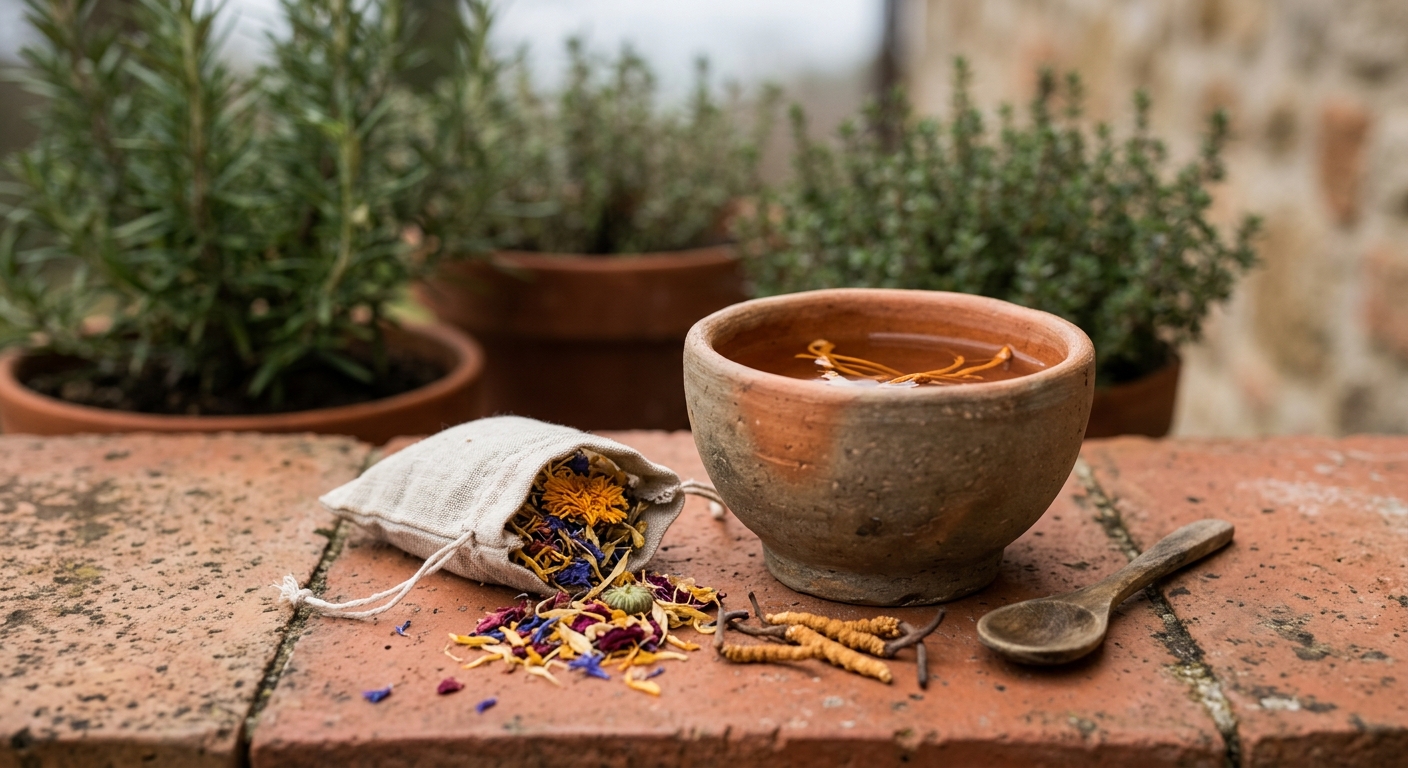
Few herbs in the world carry a backstory as dramatic as cordyceps. Long before modern sports science took interest, Tibetan herders in the high Himalayas noticed that their yaks grew unusually strong and energetic after grazing on a strange, caterpillar-like fungus poking through the alpine soil. This observation eventually reached the courts of Chinese emperors, where cordyceps became a prized tonic reserved for royalty and elite warriors. Known in Traditional Chinese Medicine as Dong Chong Xia Cao, meaning ‘winter worm, summer grass,’ it was prescribed to replenish vital energy (jing), support the lungs, and fortify the kidneys, the two organ systems most closely associated with physical stamina and endurance in classical Chinese theory.
Today, the cordyceps most widely used in herbal teas is Cordyceps militaris, a sustainably cultivated cousin of the wild Cordyceps sinensis. Grown on nutrient-rich substrates rather than insect larvae, it produces the same key bioactive compounds, including cordycepin and beta-glucans, at a fraction of the cost and without the ecological concerns tied to wild harvesting. The result is a deeply earthy, slightly nutty tea with a warm, almost umami finish that feels more grounding than stimulating. Unlike caffeine, which hijacks your nervous system for a short burst, cordyceps works at the cellular level, helping your mitochondria produce energy more efficiently over time.
Brewing cordyceps as a tea is one of the oldest and most direct ways to access its benefits. The hot water extraction process breaks down the tough fungal cell walls and releases the water-soluble polysaccharides and nucleoside compounds responsible for its adaptogenic effects. Whether you are an athlete looking to improve oxygen efficiency, a professional seeking sharper afternoon focus, or simply someone who wants to replace their second cup of coffee with something more nourishing, cordyceps tea offers a grounded, science-backed path to sustainable energy.
2
cups
Ingredients
- 2 tspdried cordyceps militaris powder or crushed fruiting bodies
- 480 mlwater (90 to 95°C / 194 to 203°F)
- —1 tsp raw honey or maple syrup (optional)
- —a pinch of cinnamon or ginger (optional, to complement the earthy flavor)
How to Brew
Click on an item below to shop for the recommended items for this recipe on Amazon.
As an Amazon Associate, we earn from qualifying purchases.
- Measure 2 teaspoons of dried cordyceps militaris powder or finely crushed fruiting bodies per 480 ml of water. If using whole dried fruiting bodies, crush them lightly in a mortar and pestle first to increase surface area.
- Bring filtered water to 90 to 95°C (194 to 203°F). Avoid a rolling boil, as temperatures above 100°C can degrade some of the heat-sensitive nucleoside compounds like cordycepin over extended brewing.
- Add the cordyceps directly to a small saucepan or heat-safe teapot. Pour the hot water over the material and cover immediately to trap volatile aromatic compounds.
- Allow the tea to steep, covered, for 15 to 20 minutes. Stir gently halfway through. The longer end of the range produces a more potent, richer brew.
- Strain through a fine mesh strainer or cheesecloth into warmed mugs. If using powder, allow the fine sediment to settle for one minute before pouring, or use a fine filter.
- Taste before adding any sweetener. A touch of raw honey or a pinch of cinnamon rounds out the earthiness beautifully. Sip slowly and enjoy within 20 minutes of brewing for peak potency.
- Use a slightly higher ratio for cold brew: 1 tablespoon of dried cordyceps militaris powder or crushed fruiting bodies per 480 ml of cold, filtered water. The cooler temperature extracts compounds more slowly, so the higher ratio compensates.
- Combine the cordyceps and water in a clean glass jar. Stir well to ensure the material is fully submerged and saturated. If using crushed fruiting bodies, give them a brief 5-minute soak to begin rehydration before sealing.
- Leave the jar at room temperature for the first hour to jumpstart extraction, then seal the lid and transfer to the refrigerator.
- Allow to steep in the refrigerator for 12 to 16 hours, or overnight. Do not exceed 20 hours as the flavor can become overly bitter.
- Strain the cold brew through a fine mesh strainer lined with cheesecloth into a clean pitcher or storage jar. Press gently on the solids to extract remaining liquid.
- Serve over ice or chilled straight. The cold brew version pairs exceptionally well with a splash of oat milk and a drizzle of honey for a refreshing afternoon tonic. Store unused cold brew in the refrigerator for up to 48 hours.
- Place 1 tablespoon of whole or roughly broken dried cordyceps militaris fruiting bodies into a small ceramic or stainless steel saucepan. Avoid aluminum cookware, which can react with acidic herbal compounds.
- Add 600 ml of cold filtered water and let the material soak for 10 minutes before applying heat. This pre-soaking step softens the tough fungal cell walls and improves overall extraction efficiency.
- Bring the water to a gentle simmer over medium-low heat, targeting 85 to 90°C (185 to 194°F). Avoid a vigorous boil. Adjust the heat to maintain a steady, gentle simmer with small bubbles rising slowly to the surface.
- Simmer uncovered for 30 to 45 minutes, stirring occasionally. The liquid will reduce and darken considerably, concentrating the polysaccharides and cordycepin. Add small amounts of hot water if the liquid drops below 200 ml.
- Remove from heat and allow the decoction to cool for 5 minutes. Strain through a fine mesh strainer or cheesecloth into a heat-safe measuring cup, pressing firmly on the solids.
- The finished decoction will be intensely earthy and concentrated. Dilute each serving with an equal part of hot water before drinking, or use the concentrate as a base to blend with ginger, licorice root, or astragalus for a traditional adaptogenic tonic formula. Divide into two servings and drink within the same day.
Health Benefits
Cordyceps has been shown in multiple human trials to increase VO2 max and improve aerobic threshold, likely by enhancing mitochondrial ATP production. A randomized controlled study published in the Journal of Alternative and Complementary Medicine found that older adults taking Cordyceps CS-4 extract showed significant improvements in exercise capacity compared to placebo after 12 weeks.
The nucleoside cordycepin supports energy metabolism at the cellular level by promoting efficient adenosine triphosphate cycling. Animal and human studies have demonstrated reduced fatigue markers, including lactic acid and blood urea nitrogen, following sustained cordyceps supplementation.
The high beta-glucan content in Cordyceps militaris activates natural killer cells and macrophages, strengthening the innate immune response. These immunomodulatory effects have been documented in both in vitro studies and clinical observations in immunocompromised patient populations.
As a classical adaptogen, cordyceps helps regulate the hypothalamic-pituitary-adrenal (HPA) axis, moderating the body’s cortisol response under physical and psychological stress. This contributes to a feeling of calm, sustained energy rather than the spike-and-crash pattern associated with stimulants.
Traditional Chinese Medicine has used cordyceps for centuries to tonify the lungs and kidneys, and modern research partially corroborates this. Studies in patients with chronic kidney disease have shown cordyceps supplementation may help preserve renal function, while its bronchodilatory properties may benefit those with mild respiratory fatigue.
🧪 Key Bioactive Compounds
The Science Behind Cordyceps
The energy-supporting effects of cordyceps tea are rooted in its influence on cellular bioenergetics, the biochemical processes by which your cells convert nutrients into usable energy. The star compound is cordycepin, a structural analog of adenosine. Because it closely resembles adenosine, a building block of ATP (adenosine triphosphate, the primary cellular energy currency), cordycepin can integrate into metabolic signaling pathways and promote more efficient ATP cycling. Research published in journals including Phytomedicine and the Journal of Ethnopharmacology has demonstrated that cordycepin also modulates the AMPK pathway, a central regulator of energy homeostasis that tells cells to produce more energy when reserves run low. This is part of the reason cordyceps-trained athletes report feeling less fatigued at the same workload rather than simply feeling stimulated.
Beyond energy metabolism, the beta-D-glucans present in Cordyceps militaris fruiting bodies interact with pattern recognition receptors on immune cells, particularly Dectin-1 receptors on macrophages and dendritic cells. This interaction triggers a calibrated immune response that enhances natural killer cell activity and cytokine regulation without causing the kind of runaway inflammation associated with immune overstimulation. This dual role, supporting both energy production and immune vigilance, is what places cordyceps firmly in the adaptogen category alongside herbs like ashwagandha and rhodiola. Adaptogens, by definition, help the body maintain homeostasis across multiple physiological systems simultaneously rather than forcing a single targeted effect.
The ergosterol content in cordyceps adds another layer of metabolic interest. As a precursor to vitamin D2, ergosterol contributes to the regulation of calcium metabolism, immune gene expression, and cellular differentiation. Meanwhile, cordycepic acid (D-mannitol) functions as an endogenous antioxidant that helps neutralize reactive oxygen species generated during aerobic exercise and metabolic stress. Studies using animal models of fatigue have consistently shown that cordyceps extract reduces accumulation of lactic acid and blood urea nitrogen after forced swimming tests, biochemical markers strongly correlated with physical exhaustion. Together, these compounds create a synergistic profile that supports energy from the mitochondria outward, making cordyceps tea one of the most scientifically interesting functional beverages in the herbal world.
Brewing Tips
- Always cover your teapot or saucepan while brewing cordyceps. Steam carries volatile aromatic compounds, and keeping them in the vessel preserves both the flavor complexity and the delicate nucleoside content of the tea.
- Start with half a teaspoon if you are new to medicinal mushroom teas. Cordyceps has a pronounced earthy, savory flavor that some people find intense at full strength initially. Your palate adapts within a few sessions and you can gradually increase to a full two-teaspoon dose.
- Pair your morning cup of cordyceps tea with a small protein-rich snack rather than drinking it on an empty stomach. The beta-glucans and polysaccharides interact more favorably with the digestive system when there is already some food present, and combining it with protein can sustain the energy effect well into midday.