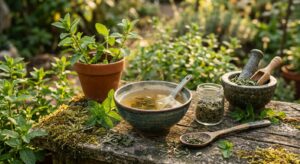
Deep in the mist-covered mountains of southern China, northern Vietnam, and Korea, a delicate climbing vine clings to forest edges and rocky slopes. Known as Gynostemma pentaphyllum, this plant has been consumed as a longevity tonic for centuries by local populations who noticed that villagers in regions where gynostemma grew wild tended to live remarkably long, active lives. Chinese herbalists dubbed it xiancao, meaning “immortality herb,” and traditional medicine systems in Japan, where it is called amachazuru, incorporated it as a daily adaptogen long before Western science had a word for that category of plants.
What makes gynostemma genuinely extraordinary is the sheer density of its bioactive saponin content. Researchers in the 1970s and 1980s, initially studying the plant in search of a natural sweetener, discovered that gynostemma contained gypenosides, a family of triterpenoid saponins structurally similar to the ginsenosides found in Panax ginseng. In fact, four of gynostemma’s gypenosides are chemically identical to ginsenosides, which is why the plant earned the informal title “Southern Ginseng” and why its effects on stamina, stress resilience, and cognitive function are so compelling. Unlike ginseng, however, gynostemma is caffeine-free, naturally slightly sweet, and gentle enough for daily long-term use by most adults.
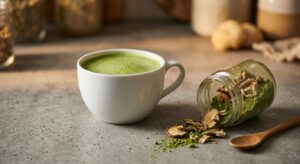
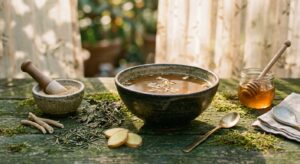
The brewed tea itself is a sensory delight that belies its potency. The leaves release a smooth, grassy sweetness with subtle vegetal depth, reminiscent of a light green tea but without the astringency or caffeine. A cup in the morning supports sustained energy through adaptogenic mechanisms rather than stimulant ones, while an evening cup can promote relaxation without sedation. Whether you are approaching gynostemma as a performance herb, a stress buffer, or simply a nourishing daily ritual, this guide will show you exactly how to brew it for maximum flavor and benefit.
2
cups
Ingredients
- 2 tspdried gynostemma leaves (jiaogulan)
- 480 mlwater (80 to 85°C / 176 to 185°F)
- —raw honey or a slice of fresh ginger to taste (optional)
How to Brew
Click on an item below to shop for the recommended items for this recipe on Amazon.
As an Amazon Associate, we earn from qualifying purchases.
- Heat filtered water to 80 to 85°C (176 to 185°F). If you do not have a temperature-controlled kettle, bring water to a boil and allow it to cool for 3 to 4 minutes before pouring.
- Measure 1 teaspoon of dried gynostemma leaves per 240 ml (8 oz) of water and place them into your tea infuser or directly into a warmed teapot.
- Pour the heated water gently over the leaves in a slow circular motion to ensure even saturation of all plant material.
- Steep for 3 to 5 minutes. Start with 3 minutes on your first brew to assess the flavor, then extend steeping time in future sessions if you prefer a stronger, more savory cup.
- Remove the infuser or strain the leaves and pour into pre-warmed mugs. Gynostemma leaves can typically be re-steeped 2 to 3 times, with each subsequent infusion revealing slightly different flavor notes. Add 1 to 2 minutes to each additional steep.
- Add 3 teaspoons of dried gynostemma leaves per 480 ml (16 oz) of cold, filtered water into a glass jar. Cold brewing requires a higher leaf-to-water ratio than hot brewing because cool water extracts compounds more slowly and less completely.
- Stir the leaves gently with a long spoon to ensure all the leaf matter is fully submerged and in contact with the water.
- Seal the jar with a lid and allow it to sit at room temperature for the first 1 to 2 hours, then transfer to the refrigerator and cold-steep for a total of 8 to 12 hours, or overnight for convenience.
- When the steep is complete, strain the liquid through a fine mesh strainer or cheesecloth into a clean pitcher or jar, pressing the leaves lightly to extract all liquid.
- Serve over ice in tall glasses. The cold brew keeps well, refrigerated and covered, for up to 3 days without significant loss of flavor or potency.
- Combine 4 tablespoons of dried gynostemma leaves with 480 ml (16 oz) of water heated to 80 to 85°C (176 to 185°F) in a small saucepan or heatproof pitcher. The leaf-to-water ratio is significantly higher than a standard cup, as the concentrate will be diluted before drinking.
- Allow the leaves to steep undisturbed for 10 to 15 minutes. This extended steeping draws out a deeper concentration of gypenosides and chlorophyll, producing a rich, jade-green liquid with a noticeably fuller flavor.
- Strain the concentrate through a fine mesh strainer into a clean glass jar, pressing the spent leaves firmly to capture every drop of the extraction.
- Allow the concentrate to cool to room temperature before sealing and refrigerating. The concentrate keeps well in the refrigerator for up to 5 days.
- To serve, dilute approximately 60 to 80 ml (2 to 2.5 oz) of concentrate with 160 to 180 ml (5.5 to 6 oz) of hot water, sparkling water, or chilled coconut water. Adjust the ratio to your taste and desired strength.
Health Benefits
Rather than stimulating the adrenal glands the way caffeine does, gynostemma enhances cellular energy production by activating AMPK pathways and improving mitochondrial efficiency. Multiple animal and preliminary human studies have documented significant reductions in fatigue markers following regular gynostemma consumption, with participants reporting cleaner, more stable energy without the crash associated with stimulants.
Gynostemma is classified as a true adaptogen because its gypenosides help normalize cortisol fluctuations and modulate the hypothalamic-pituitary-adrenal (HPA) axis response to physical and psychological stressors. A 2014 clinical study published in the Journal of the American College of Nutrition found that participants taking a standardized gynostemma extract reported significant reductions in perceived stress and anxiety compared to a placebo group.
The flavonoids quercetin and rutin, alongside gypenosides, collectively protect neurons from oxidative damage and support cerebral blood flow, creating favorable conditions for sustained attention and mental clarity. Early research also suggests that certain gypenosides may promote nerve growth factor (NGF) activity, a protein essential for the maintenance and growth of neurons involved in learning and memory.
Clinical trials have shown that gynostemma extract can meaningfully reduce LDL cholesterol and triglyceride levels while maintaining or modestly increasing HDL cholesterol, an effect attributed to its AMPK activation and antioxidant saponin content. A notable 2013 randomized controlled trial demonstrated significant improvements in lipid profiles among participants with metabolic syndrome after 12 weeks of gynostemma supplementation.
AMPK activation by gypenoside XLIX and related compounds enhances insulin sensitivity and promotes glucose uptake in muscle cells, effects comparable in mechanism to those of the diabetes medication metformin. Several human studies have documented improved fasting blood glucose and HbA1c levels in type 2 diabetic patients consuming gynostemma, suggesting meaningful benefits for metabolic health and sustained energy balance.
🧪 Key Bioactive Compounds
The Science Behind Gynostemma
The scientific interest in Gynostemma pentaphyllum accelerated dramatically once researchers identified its exceptionally high gypenoside content. Over 200 distinct gypenosides have now been isolated from the plant, a figure that dwarfs most other adaptogenic herbs in terms of saponin diversity. The most pharmacologically significant of these compounds act as modulators of AMPK, or AMP-activated protein kinase, a cellular enzyme often described as a master metabolic switch. When AMPK is activated, cells respond as if they are in an energy-conserving, highly efficient state: glucose uptake increases, fatty acid oxidation is stimulated, mitochondrial biogenesis is promoted, and inflammatory signaling is attenuated. This is the core biochemical reason why gynostemma drinkers report improvements in energy, metabolic markers, and even body composition over time.
The structural overlap between gypenosides and ginsenosides is not merely a curiosity. At least four gypenosides, including Rb1 and Rd, are chemically identical to ginsenosides found in Panax ginseng, meaning that gynostemma delivers some of the same signaling molecules at the neurological and endocrine level that have made ginseng one of the world’s most studied medicinal plants. These shared compounds interact with glucocorticoid receptors, modulate neurotransmitter synthesis, and support HPA axis normalization, providing a biochemical basis for the herb’s well-documented adaptogenic and nootropic effects. Unlike ginseng, however, gynostemma grows abundantly, is caffeine-free, and is considerably more affordable, making long-term daily use realistic for most people.
Beyond its saponin profile, gynostemma contributes meaningful quantities of the flavonoids quercetin and rutin, both of which have independent bodies of research supporting neuroprotective, anti-inflammatory, and vasoprotective effects. Quercetin in particular has been shown to inhibit neuroinflammatory pathways mediated by NF-kB and to protect hippocampal neurons from oxidative insult, offering a plausible mechanism for the subjective improvements in focus and mental clarity that habitual gynostemma drinkers describe. When these flavonoids work in concert with gypenoside-driven AMPK activation and improved cerebral circulation, the result is a multi-pathway approach to cognitive support that is genuinely distinct from the single-pathway stimulation of caffeine or even isolated ginseng extracts.
Brewing Tips
- Always use water below 90°C (194°F) when brewing gynostemma. Boiling water can break down the more delicate gypenosides and introduce bitterness from excessive chlorophyll extraction, undermining both the flavor and some of the bioactive potential of the brew.
- Gynostemma leaves are remarkably forgiving and well-suited to multiple infusions. Keep your spent leaves after the first steep and brew them a second and even third time, adding 60 to 90 seconds of additional steep time with each subsequent infusion. The flavor shifts across steeps, often becoming mellower and slightly more vegetal.
- For best adaptogenic results, consume gynostemma consistently over weeks rather than relying on a single cup for immediate effects. Adaptogens work cumulatively by gradually recalibrating stress response systems and metabolic function. A daily cup for four to six weeks is where most people begin to notice meaningful changes in energy stability and stress resilience.