Agarikon (Fomitopsis officinalis, formerly Laricifomes officinalis) is a polypore mushroom that grows on old-growth conifers across the Pacific Northwest, British Columbia, and parts of Europe. It is among the longest-lived organisms in the fungal kingdom, with individual fruiting bodies surviving for decades and growing to extraordinary sizes. The ancient Greeks called it the “elixir of long life,” and the physician Dioscorides documented its use as far back as 65 CE, prescribing it for consumption, fevers, and infections at a time when few other remedies existed. Indigenous peoples of the Pacific Northwest likewise revered agarikon, carving its dense, woody fruiting bodies into sacred effigies and using it ceremonially and medicinally for generations.
What makes agarikon so remarkable is its near-extinction status in much of the world, largely due to the logging of old-growth forests. The fruiting bodies require centuries-old conifers to establish themselves, making wild agarikon a rare and precious find. Today, mycologist Paul Stamets and the team at Fungi Perfecti have championed agarikon’s revival, cultivating it and publishing research into its antiviral compounds that has attracted attention from institutions including the U.S. Department of Defense for its potential against bioterrorism pathogens. Brewing a tea from cultivated agarikon powder or sliced dried mycelium brings this ancient remedy into modern kitchens with accessibility and intention.
Unlike delicate herbal teas, agarikon is dense, woody, and fibrous, requiring heat and extended steeping or simmering to coax its bioactive compounds into the water. The resulting brew is earthy, slightly bitter, and resinous, with a complexity that speaks to the mushroom’s coniferous forest origins. It is most often taken as a daily tonic rather than a casual cup, valued for its cumulative immune-supporting effects over time rather than any single dramatic result.
2
cups
Ingredients
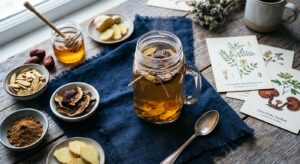
- 2 tspdried agarikon mushroom powder or finely sliced dried agarikon
- 500 mlwater (just below boiling, 95 to 98°C / 203 to 208°F)
- —raw honey or maple syrup to taste (optional)
- —a small cinnamon stick or slice of fresh ginger (optional, to balance bitterness)
How to Brew
Click on an item below to shop for the recommended items for this recipe on Amazon.
As an Amazon Associate, we earn from qualifying purchases.
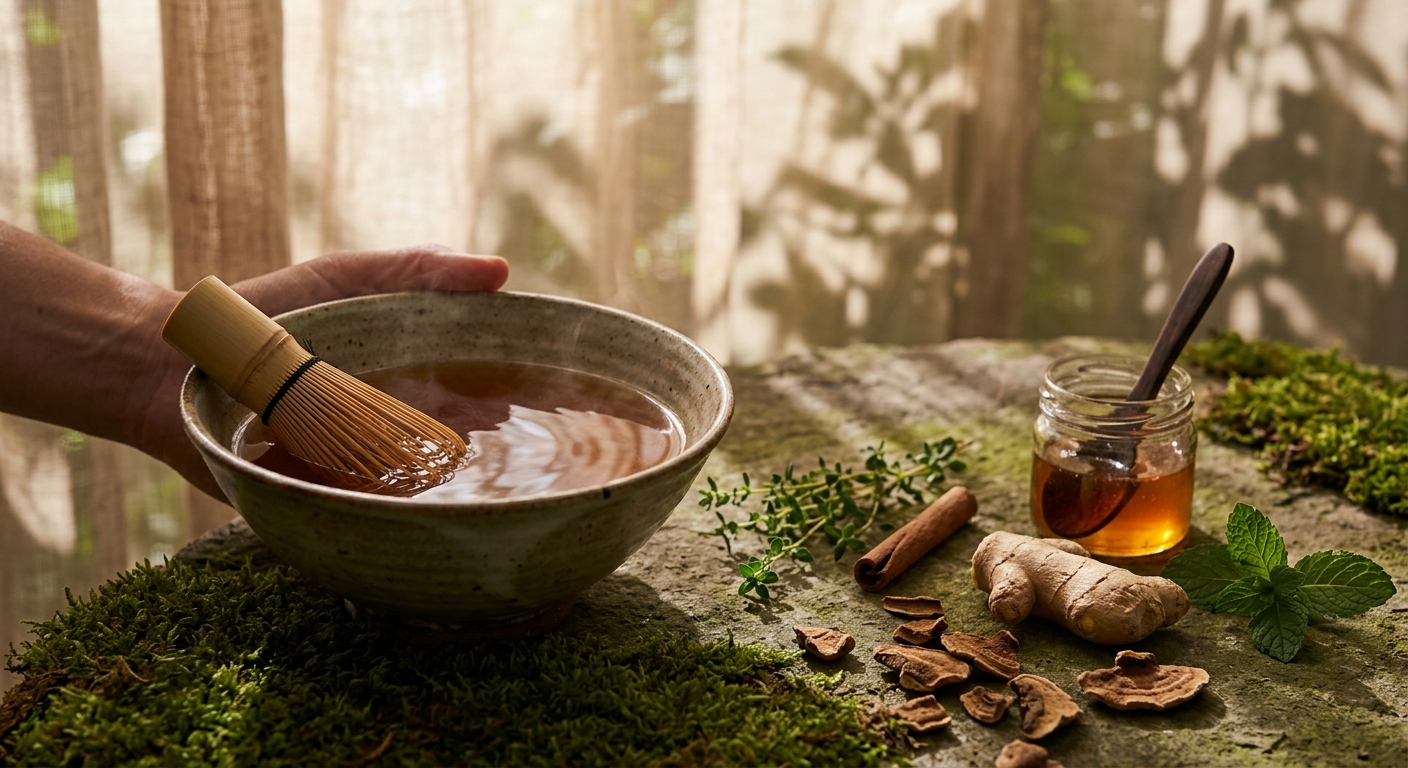
- Measure 2 teaspoons of dried agarikon powder or finely sliced dried agarikon into a small saucepan or heat-safe teapot. If using sliced pieces rather than powder, break them into the smallest fragments possible to maximize surface area.
- Bring 500 ml of filtered water to just below a full boil, approximately 95 to 98°C (203 to 208°F). Avoid a hard rolling boil, which can degrade some heat-sensitive polysaccharides.
- Pour the hot water directly over the agarikon. If using a saucepan, set it over the lowest possible heat to maintain a gentle simmer throughout steeping. If using a teapot, wrap it in a cloth to retain heat.
- Steep for 20 to 30 minutes, stirring once at the halfway point. The brew will darken steadily from amber to a rich tawny brown as beta-glucans and resinous triterpenes extract into the water.
- Strain through a fine mesh strainer or a piece of cheesecloth into your mug, pressing the spent mushroom material firmly to extract every drop of liquid.
- Add raw honey, maple syrup, or a squeeze of lemon to taste. Serve immediately and drink while warm for the best bioavailability of fat-soluble compounds.
- Measure 3 teaspoons of dried agarikon powder or very finely ground dried slices into a clean glass jar. Use slightly more mushroom than you would for hot brewing, since cold water is a less efficient solvent for polysaccharides.
- Pour 500 ml of cool, filtered water (room temperature, not ice cold) over the agarikon. Stir well with a long spoon to fully saturate the powder and prevent clumping at the bottom.
- Seal the jar loosely with a lid or cover with a clean cloth secured with a rubber band. Let it sit at room temperature for the first 2 hours, stirring once, to begin the extraction process before moving it to the refrigerator.
- Transfer the jar to the refrigerator and allow it to cold brew for a further 16 to 22 hours, for a total steep time of 18 to 24 hours. Give the jar a gentle shake or stir once during this period.
- When ready, strain the cold brew through a fine mesh strainer lined with cheesecloth into a clean pitcher or bottle, pressing the spent material firmly to extract all liquid.
- Serve over ice or blend into a morning smoothie with banana, almond milk, and a teaspoon of raw honey. Store any remaining cold brew in the refrigerator and consume within 48 hours.
- Add 3 teaspoons of dried agarikon powder or broken dried slices to a small stainless steel or ceramic saucepan. If you have whole chunks of dried agarikon, use a mortar and pestle to break them into coarse fragments before adding to the pot.
- Pour 600 ml of cold, filtered water directly into the saucepan with the mushroom material. Starting in cold water allows a gradual temperature rise that helps draw out polysaccharides more completely than adding mushroom to pre-boiled water.
- Place the saucepan over medium heat and slowly bring the liquid up to a gentle simmer, approximately 85 to 90°C (185 to 194°F). Do not allow it to reach a hard boil. Adjust the burner to maintain a steady, low simmer with small bubbles breaking at the surface.
- Simmer uncovered for 40 to 60 minutes, stirring every 10 minutes. The liquid will reduce by roughly 20 to 25 percent. If it reduces too quickly, add a small splash of hot water to maintain volume. The finished decoction should be a deep mahogany brown.
- Remove from heat and allow to cool for 5 minutes. Strain through a fine mesh strainer lined with cheesecloth into a heatproof measuring jug or teapot, pressing the mushroom solids firmly to extract all liquid. Discard the spent material.
- Pour into mugs and sweeten lightly with honey or a small piece of licorice root if desired to offset the natural bitterness. This decoction can also be stored in the refrigerator for up to 3 days and gently reheated as needed, making it ideal for a multi-day immune support protocol.
Health Benefits
Agarikon’s high concentration of beta-1,3/1,6-glucans binds to receptors on macrophages and natural killer cells, priming the immune system for faster and more efficient pathogen response. Unlike simple immune stimulants, beta-glucans modulate immune activity bidirectionally, potentially reducing overactivation as well as underactivation.
Laboratory research supported by the National Institutes of Health and conducted by Stamets et al. found that agarikon extracts showed inhibitory activity against multiple flu strains, poxvirus, and herpes simplex virus. While human clinical trials are still limited, the in vitro and in vivo data are compelling enough to have attracted funding from the U.S. Biodefense Advanced Research and Development Authority.
Historically, agarikon was used by Dioscorides and later by European physicians specifically for pulmonary complaints including chronic cough, tuberculosis-like wasting diseases, and bronchitis. Modern research suggests its anti-inflammatory triterpenes and antiviral compounds may support respiratory mucosal immunity, particularly during seasonal illness.
The lanostane-type triterpenes found in agarikon inhibit key inflammatory signaling molecules including NF-kB, reducing systemic inflammatory load. This action may be particularly relevant for conditions involving chronic low-grade inflammation that compromises immune surveillance.
Ethnobotanical records and early pharmacological studies document agarikon’s use against bacterial infections, particularly those affecting the lungs and digestive tract. Oxalic acid and other organic acids in the fruiting body contribute to a broad antimicrobial profile that complements its antiviral activity.
🧪 Key Bioactive Compounds
The Science Behind Agarikon Mushroom
The most thoroughly studied bioactive compounds in agarikon are its high-molecular-weight beta-1,3/1,6-glucans, a class of polysaccharides that interact directly with pattern recognition receptors on immune cells, particularly Dectin-1 receptors found on macrophages, neutrophils, and dendritic cells. When beta-glucans bind to Dectin-1, they trigger a signaling cascade that activates these cells, enhancing their phagocytic activity and increasing the production of cytokines and chemokines that coordinate a broader immune response. This mechanism is why beta-glucan-rich mushrooms like agarikon are described as immune modulators rather than simple stimulants: they improve the immune system’s readiness and coordination without simply flooding the body with inflammatory signals.
Agarikon also contains a distinctive group of compounds not found in comparable concentrations in other medicinal mushrooms. Agaricic acid, a polyhydroxy fatty acid unique to Fomitopsis officinalis, has been identified in NIH-funded research as a candidate antiviral agent with inhibitory activity against pox viruses and influenza strains. The lanostane-type triterpenes found in agarikon act on NF-kB inflammatory pathways in a manner comparable to the well-documented ganoderic acids in reishi mushroom, suggesting that the broader Fomitopsis family shares some of the anti-inflammatory pharmacology that has made reishi famous. Ergosterol, the primary sterol in fungi (analogous to cholesterol in animals), serves as a provitamin D2 precursor and has demonstrated antiproliferative effects in several cellular studies, adding another layer to agarikon’s immunological activity.
It is important to note that the majority of compelling research on agarikon, including the widely cited Stamets studies, has been conducted in vitro or in animal models, and robust double-blind human clinical trials remain scarce. This is partly because agarikon is rare and expensive to cultivate at scale and partly because funding for medicinal mushroom human trials has historically been limited outside of Japan and China, where mushroom medicine has a stronger institutional foothold. The existing data is promising and the traditional evidence spanning nearly two millennia is substantial, but consumers should understand that agarikon tea is best approached as a supportive daily tonic with a strong historical and mechanistic rationale, not as a clinically proven pharmaceutical treatment.
Brewing Tips
- Always use cultivated agarikon from a certified organic or third-party tested source. Wild harvesting is ecologically damaging given the mushroom’s endangered status, and unverified wild specimens may carry contaminants from polluted forest substrates.
- Agarikon powder produces a slightly more bitter brew than sliced dried pieces because more surface area is exposed to water. If bitterness bothers you, start with coarsely broken dried slices and reduce to powder only when you want maximum potency.
- Consistency matters more than any single dose. Traditional use and modern functional medicine both emphasize that medicinal mushrooms like agarikon deliver their immune benefits cumulatively over weeks of regular use, rather than in a single strong cup.
- Save the spent mushroom solids from your decoction in a freezer container and accumulate several batches before discarding. A second extraction from frozen solids (simmered again for 30 minutes) yields a lighter but still bioactive secondary brew worth drinking.
- If you find the resinous, piney bitterness of agarikon challenging, blend it with dried elderberries and a cinnamon stick during brewing. The elderberries add natural sweetness and their own antiviral flavonoids, making the blend more palatable and more potent for cold and flu season.