Long before modern immunology gave us the language of T-cells and cytokines, Chinese physicians were prescribing Astragalus membranaceus, known in Traditional Chinese Medicine as Huang Qi or “yellow leader,” to build vitality and ward off illness. Classified as a superior tonic herb in the Shennong Bencao Jing, one of the oldest Chinese materia medica texts, astragalus root was believed to tonify the wei qi, the protective energy that shields the body from external pathogens. That ancient intuition has held up remarkably well under modern scientific scrutiny, making astragalus one of the most studied adaptogenic herbs in the world.
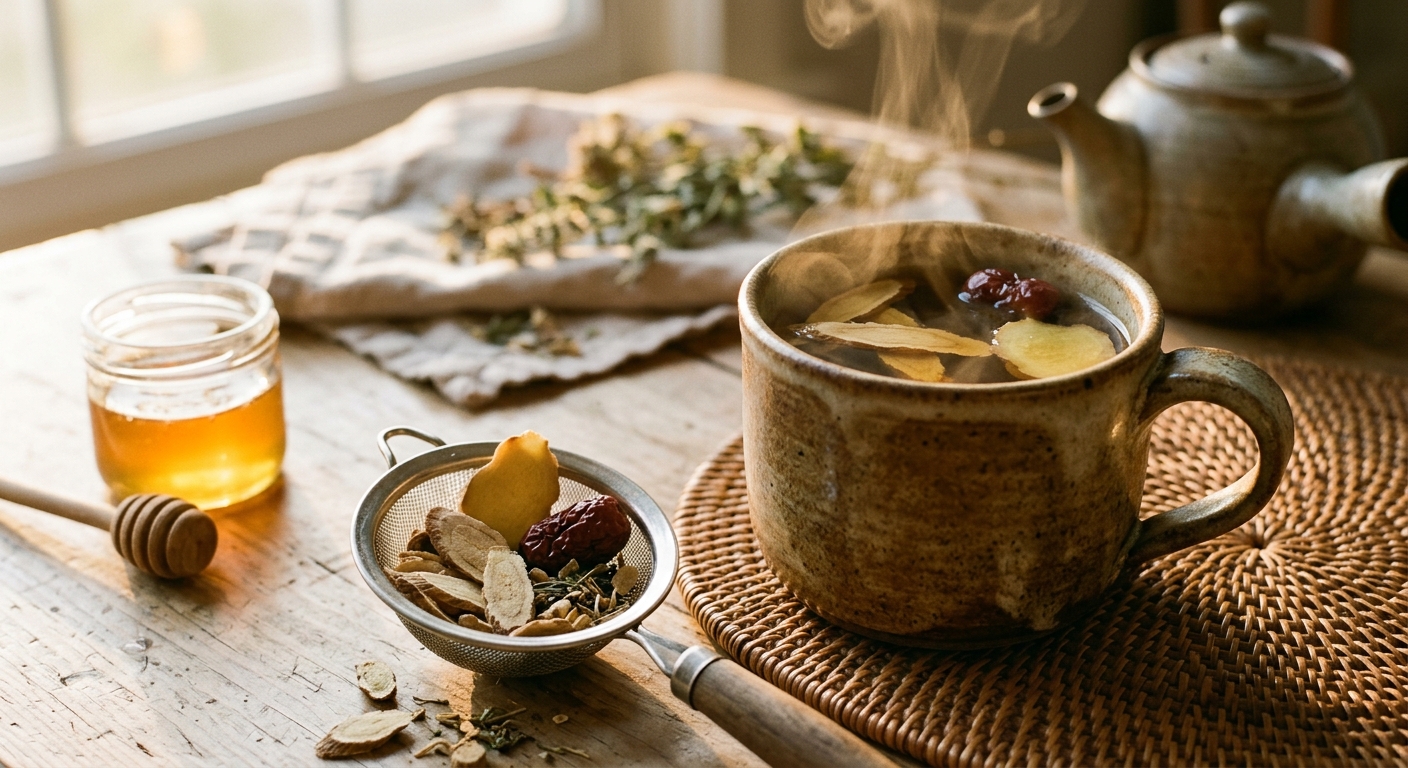
The root itself is harvested from a perennial legume native to northern and eastern China, Mongolia, and Korea. After four to seven years of growth, the roots are dried and sliced into the flat, tongue-depressor-like pieces that are now sold in herb shops and health food stores worldwide. These pale yellow slices have a subtly sweet, woody aroma and a flavor that sits somewhere between fresh green peas and mild licorice root, earthy and grounding without being bitter or medicinal in an off-putting way. Brewing them low and slow draws out the full spectrum of polysaccharides, saponins, and flavonoids that give astragalus its remarkable reputation.
Unlike many immune herbs that work best taken at the first sign of illness, astragalus is best used as a long-term tonic. Herbalists and integrative practitioners typically recommend drinking it consistently over weeks or months to build and sustain immune resilience, rather than as an acute cold remedy. This makes it a wonderful base for a daily wellness tea, especially through the autumn and winter months when immune support matters most. Whether you brew it as a slow decoction, steep it cold overnight, or blend it into a warming daily cup, astragalus root is a deeply nourishing addition to any herbal practice.
2
cups
Ingredients
- 15 gdried astragalus root slices
- 500 mlfiltered water
- —raw honey or jujube dates to taste (optional)
- —a slice of fresh ginger (optional, for warming depth)
How to Brew
Click on an item below to shop for the recommended items for this recipe on Amazon.
As an Amazon Associate, we earn from qualifying purchases.
- Measure 15 g of dried astragalus root slices and rinse them briefly under cold water to remove any dust or debris from the drying process.
- Place the rinsed root slices in a small stainless steel or ceramic saucepan with 600 ml of filtered water. Starting with extra water accounts for evaporation during simmering.
- Bring the water to a full rolling boil over medium-high heat, then immediately reduce the heat to a gentle simmer. You want small, steady bubbles, not a vigorous boil.
- Simmer uncovered for 20 to 30 minutes, checking occasionally. The liquid will reduce and deepen to a warm amber or golden color.
- Remove from heat and allow the decoction to rest for 5 minutes. Strain through a fine mesh strainer into two prewarmed mugs, pressing the root slices gently to extract the last of the liquid.
- Add raw honey, a few pitted jujube dates, or a slice of fresh ginger to taste. Drink warm, ideally in the morning as a daily tonic or in the early evening.
- Place 15 g of dried astragalus root slices into a clean glass jar. Because no heat is applied, rinse the slices thoroughly under cold running water for 30 seconds to ensure cleanliness.
- Pour 600 ml of cold, filtered water over the root slices. The cold water will slowly draw out the water-soluble polysaccharides and flavonoids over a long extraction period.
- Seal the jar with a lid and leave it at room temperature for one hour to begin the extraction, then transfer it to the refrigerator.
- Allow the jar to steep in the refrigerator for a total of 10 to 14 hours, ideally overnight. The resulting liquid should be a very pale gold, lighter in color than the hot decoction but still fragrant.
- Strain through a fine mesh strainer or a nut milk bag into a clean pitcher or directly into glasses. Discard the spent root slices.
- Drink cold or allow to come to room temperature before serving. Cold brew astragalus keeps refrigerated for up to 48 hours. Add a few drops of raw honey stirred in before drinking if desired.
- Combine 40 g of dried astragalus root slices with 1 liter of filtered water in a medium saucepan. This larger root-to-water ratio is intentional for creating a strong concentrate.
- Bring to a full boil over medium-high heat, then reduce immediately to a low, steady simmer. Cover the pot partially with a lid to slow evaporation while still allowing some steam to escape.
- Simmer for 45 to 60 minutes, stirring occasionally, until the liquid has reduced by roughly half to approximately 500 ml. The color should be a deep warm amber and the flavor noticeably sweet and earthy.
- Remove from heat and allow to cool for 10 minutes. Strain through a fine mesh strainer lined with cheesecloth into a clean glass jar, pressing the root slices firmly to extract all remaining liquid.
- Let the concentrate cool to room temperature before sealing the jar. Store in the refrigerator for up to five days or freeze into ice cube trays for longer storage (up to three months).
- To use: stir 60 to 90 ml of concentrate into 150 to 180 ml of hot water for an instant tonic tea, or blend a portion into warm broths, golden milk, or smoothies.
Health Benefits
Astragalus polysaccharides are well-documented immunomodulators that stimulate macrophage activity, increase natural killer cell counts, and promote balanced cytokine responses. Multiple clinical trials have demonstrated that regular astragalus supplementation significantly improves immune function markers in both healthy adults and immunocompromised patients.
Astragalus is classified as an adaptogen, meaning it helps the body maintain homeostasis under physical and psychological stress. The saponin and polysaccharide fractions work together to regulate the hypothalamic-pituitary-adrenal axis, reducing stress-induced immune suppression.
The isoflavonoids calycosin and formononetin, along with astragaloside IV, contribute significant antioxidant activity, neutralizing free radicals and reducing markers of chronic inflammation such as interleukin-6 and tumor necrosis factor-alpha.
Several studies have found that astragaloside IV supports healthy blood pressure, improves heart function in patients with chronic heart failure, and protects endothelial cells from oxidative damage, suggesting benefit beyond immune health alone.
Cycloastragenol, the aglycone of astragaloside IV, is among the very few natural compounds shown to activate telomerase in human cells in vitro. While research is still preliminary, this has generated significant scientific interest in astragalus as a potential agent for supporting healthy aging at the cellular level.
🧪 Key Bioactive Compounds
The Science Behind Astragalus
The immune-supporting reputation of astragalus rests on a well-studied class of compounds called Astragalus Polysaccharides, or APS. These complex carbohydrate chains act as biological response modifiers, meaning they do not simply suppress or stimulate the immune system but rather help it calibrate an appropriate response. Research published in journals including the International Immunopharmacology and the Journal of Ethnopharmacology has demonstrated that APS increases the proliferation and activity of macrophages, the immune system’s frontline phagocytic cells, while also boosting natural killer cell cytotoxicity. APS also promotes the maturation of dendritic cells, which are critical for presenting antigens and activating T-lymphocyte responses in adaptive immunity. This makes astragalus particularly valuable as a preventive tonic rather than an acute treatment.
Astragaloside IV, one of the primary saponin glycosides isolated from the root, has attracted intense scientific interest for its multi-system activity. In animal and in vitro models, it has demonstrated the ability to inhibit NF-kB signaling, a key pathway in inflammatory cascades, which explains the herb’s traditional role in managing chronic inflammatory conditions. More strikingly, its aglycone form, cycloastragenol, has been shown in multiple studies to activate telomerase, the enzyme that maintains the protective end-caps on chromosomes known as telomeres. Shortened telomeres are associated with cellular senescence and aging-related disease, and while human clinical data on telomerase activation remains early stage, the findings have positioned cycloastragenol as one of the most intriguing natural compounds in longevity research.
The isoflavonoids in astragalus, particularly calycosin and formononetin, add an antioxidant and phytoestrogenic dimension to the root’s activity profile. These compounds have demonstrated free radical scavenging capacity comparable to that of vitamin C in certain assay models, and they contribute to the herb’s protective effects on endothelial cells lining blood vessels. A 2014 meta-analysis examining astragalus in patients with chronic heart failure found significant improvements in left ventricular function and reduced hospitalization rates compared to conventional treatment alone, lending clinical weight to the cardiovascular benefits suggested by laboratory research. Taken together, the scientific picture of astragalus is that of a genuinely complex, multi-target herb whose traditional classification as a superior tonic herb is increasingly supported by modern evidence.
Brewing Tips
- Do not discard the spent astragalus root slices after your first decoction. They can be added to soups, broths, or rice dishes and simmered for an additional hour to extract any remaining beneficial compounds before composting.
- For maximum polysaccharide extraction in a hot decoction, keep the simmer low and steady rather than boiling aggressively. High rolling boils can degrade some of the delicate polysaccharide chains you are trying to preserve.
- Combine astragalus with reishi mushroom slices, schisandra berries, or codonopsis root to create a classic Chinese immune tonic formula. These herbs are traditionally used together and their compounds appear to have synergistic effects on immune regulation.
- Look for astragalus root from certified organic sources and check that it is Astragalus membranaceus (also labelled Astragalus mongholicus), not one of the hundreds of other astragalus species that do not share the same medicinal properties.
- Consistency matters more than quantity with astragalus. Drinking one cup daily for eight to twelve weeks will produce more meaningful immune benefits than drinking large amounts sporadically. Treat it as a daily ritual rather than an occasional supplement.