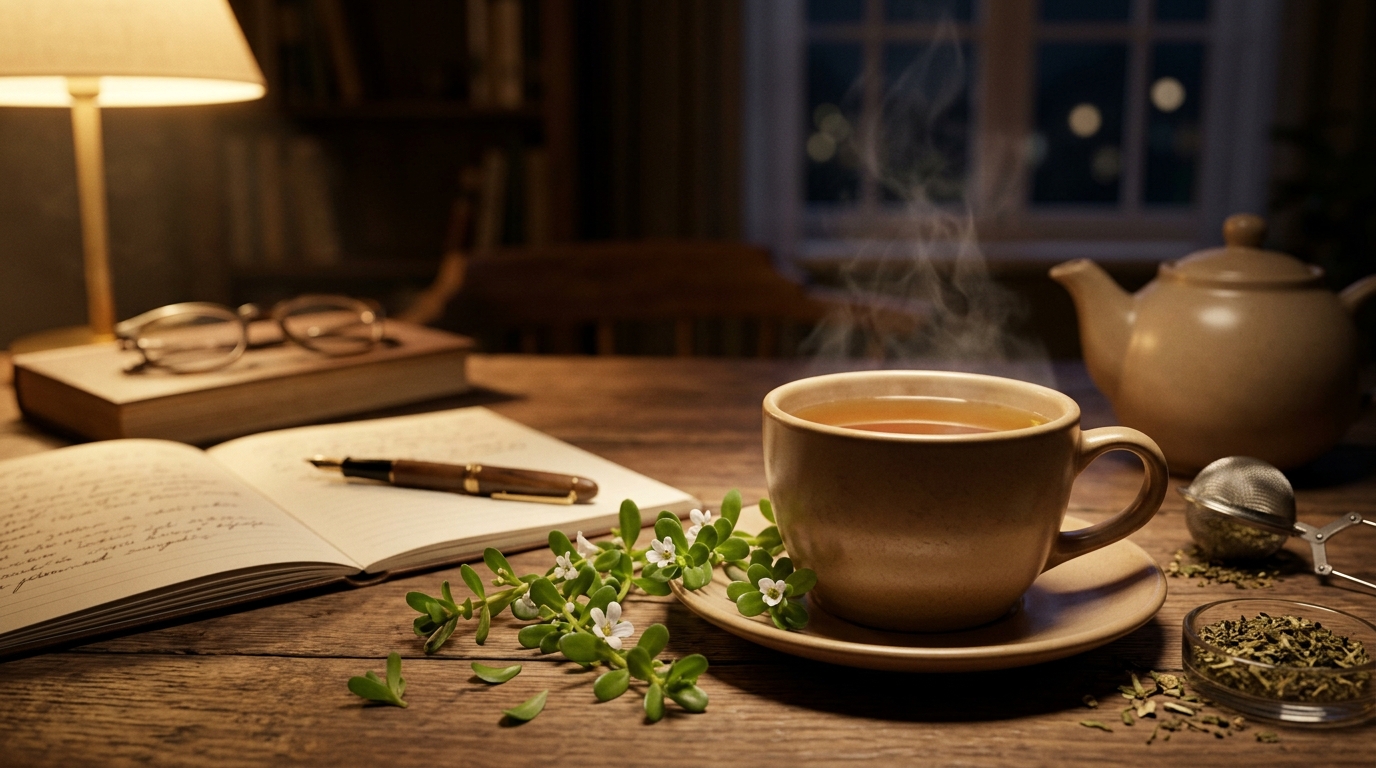
For more than three thousand years, Bacopa monnieri has held a place of honor in Ayurvedic medicine. Called brahmi in Sanskrit, a name linked to Brahma, the creator in Hindu tradition, this small, succulent-leaved plant grows in marshes and along riverbanks across India, Southeast Asia, and parts of Australia. Ancient scholars and students reportedly chewed or steeped the herb to help memorize lengthy Vedic hymns, and it was classed as a medhya rasayana, a category of herbs meant to nourish the intellect.
What makes bacopa so intriguing today is that modern research has begun to echo those old teachings. Several randomized controlled trials suggest that consistent use over eight to twelve weeks may improve memory retention and speed of information processing, particularly for learning new material. Unlike coffee or black tea, bacopa does not stimulate the nervous system. Its reputation is closer to the opposite: a settled, steady clarity that suits the quiet hours of evening study.
In the cup, bacopa is an honest, unvarnished tea. It tastes green, earthy, and distinctly bitter, with a faint woodiness that some compare to a stronger cousin of green tea. Most people soften it with a little honey, a squeeze of lemon, or a blend with gentler herbs like tulsi or mint. Treat it as a ritual rather than a refreshment, a signal to the mind that it is time to settle in and focus.
2
cups
Ingredients
- 2 tspdried bacopa monnieri leaf (cut and sifted)
- 480 mlfiltered water (95°C / 203°F)
- 1 tspfresh lemon juice (optional)
- —raw honey or jaggery to taste (optional)
- —a few fresh mint or tulsi leaves for softening the bitterness (optional)
How to Brew
Click on an item below to shop for the recommended items for this recipe on Amazon.
As an Amazon Associate, we earn from qualifying purchases.
- Measure 2 teaspoons of dried bacopa leaf into a tea infuser or directly into a warmed teapot. If using whole dried leaf, gently crush it between your fingers first to release more of the active saponins.
- Bring filtered water to a full boil, then let it rest for about 30 seconds so it settles near 95°C (203°F). Water that is too violently boiling can make the tea harsher and more astringent.
- Pour the hot water over the leaves, cover the vessel with a lid or saucer to trap the volatile aromatics, and set a timer for 8 minutes.
- Taste at the 8-minute mark. If you want more body and a deeper green flavor, let it steep up to 10 minutes. Beyond that, bitterness climbs quickly.
- Strain into your mug, pressing the leaves gently against the infuser to extract the last of the liquid.
- Stir in honey and a few drops of lemon juice if desired. Sip slowly while you read or review your notes.
- Add 3 teaspoons of dried bacopa leaf to a clean glass jar. Cold brewing is gentler, so use a slightly higher leaf-to-water ratio than you would for a hot cup.
- Pour in 500 ml of cool filtered water and stir once to wet all of the leaves. Do not use warm water, which would begin extracting bitter compounds.
- Seal the jar and refrigerate for 8 to 12 hours. Overnight is ideal, since the long, slow extraction mellows the earthy notes into something soft and almost sweet.
- Strain through a fine mesh sieve or a double layer of muslin to remove all plant fragments. Bacopa leaves are small and can slip through a coarse strainer.
- Serve over ice with a thin slice of lemon or a sprig of mint. Consume within 24 hours, as the tea will not keep as long as a hot brew.
- Combine 2 teaspoons of dried bacopa with 300 ml of cold water in a small stainless steel or enamel saucepan. Starting with cold water allows the plant material to release its compounds gradually.
- Bring the pot slowly to a gentle simmer over medium-low heat. Watch for small bubbles at the edges rather than a rolling boil, which would drive off aromatics and increase bitterness.
- Reduce the heat to low, partially cover, and simmer for 10 minutes, until the liquid has reduced by roughly one quarter and turned a deep green-gold.
- Remove from the heat and let the decoction rest, covered, for 5 minutes so the flavors can round out.
- Strain into a mug. For a traditional preparation, stir in a small spoonful of ghee or a splash of warm milk and a pinch of cardamom, which helps balance the bitterness and may aid absorption of bacopa’s fat-soluble constituents.
Health Benefits
Multiple randomized trials and meta-analyses report improved memory acquisition and retention after 8 to 12 weeks of regular bacopa use. The effect appears gradual rather than immediate, so consistency matters more than any single cup.
Bacopa is classified as an adaptogen and nootropic that may reduce perceived stress and anxiety without the jitters of caffeine. This makes it a sensible choice for evening study when you want clarity without compromising sleep.
Its bacosides and flavonoids have shown antioxidant and anti-inflammatory activity in laboratory and animal studies, supporting the idea that bacopa helps protect brain cells from oxidative damage over time.
Some human trials found faster visual information processing and reduced reaction times in participants taking standardized bacopa extracts, though results vary with dose and preparation.
Small studies suggest bacopa may lower cortisol and improve mood, helping ease the mental fatigue that builds during long study or work sessions.
🧪 Key Bioactive Compounds
The Science Behind Bacopa Monnieri
The memory-supporting reputation of bacopa rests largely on its triterpenoid saponins, collectively called bacosides. In animal studies, these compounds appear to enhance the growth of dendrites, the branching extensions of neurons that receive signals from other cells. More dendritic branching may translate into richer connections between neurons, which is a plausible mechanism for improved learning. Bacosides have also been shown to modulate the activity of acetylcholine, a neurotransmitter central to memory formation, by influencing the enzymes that build and break it down.
Bacopa also acts as an antioxidant in neural tissue. Laboratory studies show that bacoside-rich extracts can scavenge free radicals and boost the activity of the body’s own protective enzymes, such as superoxide dismutase and catalase. Because the brain consumes a great deal of oxygen and is rich in easily oxidized fats, protection against oxidative stress is considered especially valuable for long-term cognitive health. The flavonoids luteolin and apigenin add further anti-inflammatory support.
It is important to keep the evidence in perspective. Most of the positive human data comes from standardized extracts taken daily for at least two to three months, and the benefits tend to build slowly. A cup of tea delivers a smaller and less standardized dose, so it is best viewed as a supportive daily ritual rather than a quick cognitive fix. Pairing it with good sleep, regular study habits, and a balanced diet is likely to serve your memory better than the herb alone.
Brewing Tips
- Drink bacopa tea with or just after a small snack to reduce the chance of stomach upset, and avoid it on a completely empty stomach.
- Give it time. The memory benefits seen in studies emerged after 8 to 12 weeks of consistent use, so make it a nightly habit rather than an occasional cup.
- Soften the bitterness with raw honey, a squeeze of lemon, or by blending with mint, tulsi, or a pinch of cardamom rather than over-steeping to compensate.
- Because bacopa is fat-soluble in its active compounds, enjoying it with a little ghee or milk in the traditional style may improve how well you absorb it.
- Store dried bacopa in an airtight, opaque container away from light and moisture to preserve its aroma and potency.