Long before energy gels and sports drinks lined the shelves of cycling shops, endurance athletes relied on plant medicine to fuel their efforts. Green tea has powered centuries of exertion in East Asian culture, where Buddhist monks and samurai alike drank it to sustain alertness through long hours of meditation and physical discipline. Ginger root was a prized tonic among traditional Ayurvedic and Chinese physicians for warming the body, improving circulation, and reducing inflammation after hard effort. Peppermint, celebrated in European herbal traditions since at least the 18th century, was brewed to open the airways and invigorate the senses before demanding physical tasks. Eleuthero root, sometimes called Siberian ginseng, was studied extensively by Soviet researchers in the 1960s who sought natural compounds to enhance the stamina and recovery of Olympic athletes and cosmonauts.
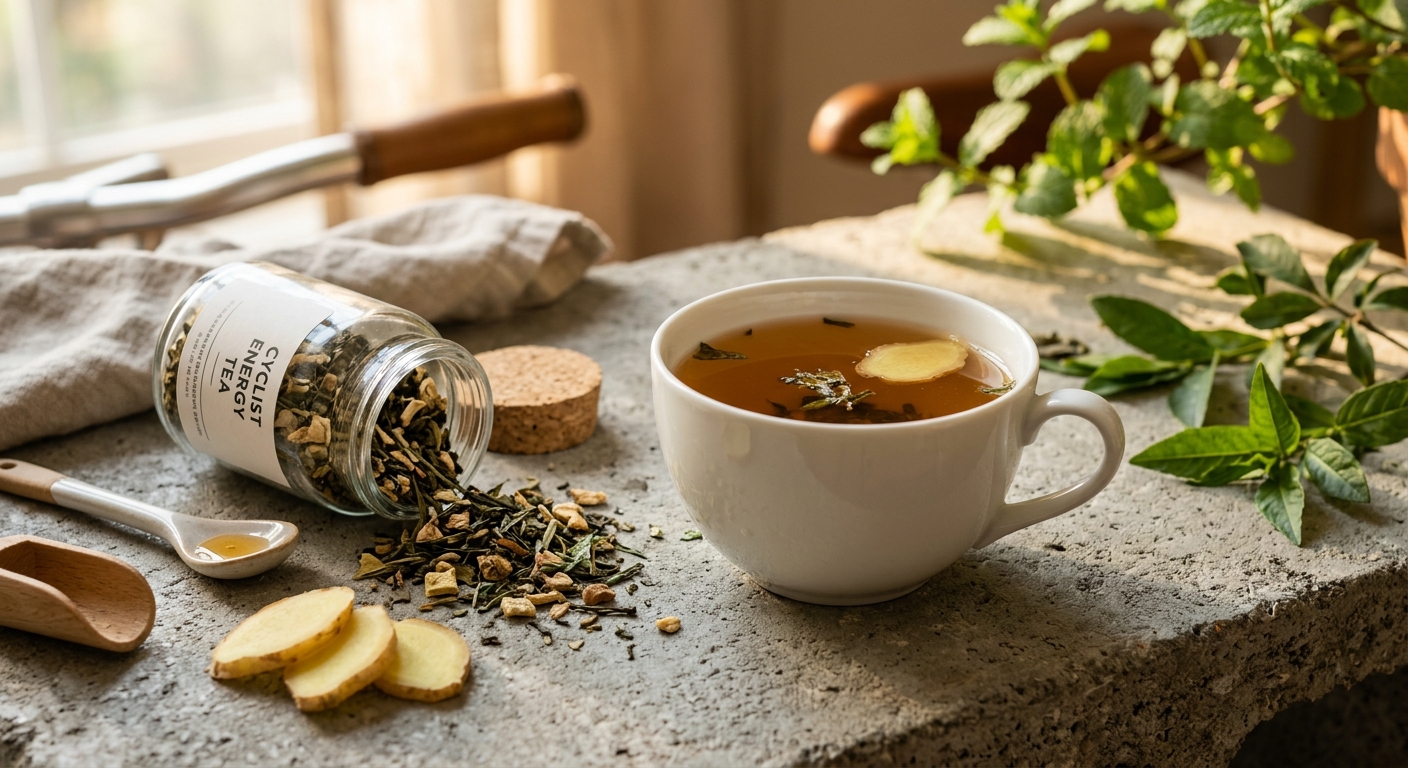
Cyclist Energy Tea brings these four time-tested herbs together in a formula that addresses every stage of a ride: the alertness needed at the start, the sustained power required through the middle miles, and the anti-inflammatory support that helps your legs recover after the effort is done. Unlike caffeine-only energy drinks that spike cortisol and leave you hollow an hour later, this blend layers fast-acting caffeine from green tea with the adaptogenic resilience of eleuthero, the circulatory stimulation of ginger, and the airway-opening freshness of peppermint to create a genuinely athletic experience in a cup.
This tea is as pleasurable to drink as it is functional. The pale jade liquor carries a bright, grassy sweetness from green tea, a warm spiced heat from ginger, a cool menthol finish from peppermint, and a subtle earthy undertone from eleuthero. Brew it hot before a morning ride, cold brew it overnight for a chilled bottle you can grab and go, or prepare a concentrate and dilute it into your water bottle for sipping on the bike. However you make it, Cyclist Energy Tea is a ritual worth adding to your pre-ride routine.
2
cups
Ingredients
- 2 tsploose-leaf green tea (e.g. sencha or gunpowder)
- 1 tspdried peppermint leaves
- 1 tspeleuthero root (Eleutherococcus senticosus), finely chopped or granulated
- 4 slicesfresh ginger root (each slice approximately 3mm thick)
- 480 mlwater (80°C / 176°F for hot brew)
- —raw honey or maple syrup to taste (optional)
- —lemon wedge for serving (optional)
How to Brew
Click on an item below to shop for the recommended items for this recipe on Amazon.
As an Amazon Associate, we earn from qualifying purchases.
- Bring 600 ml of filtered water to a boil, then allow it to cool for 5 to 6 minutes until it reaches approximately 80°C (176°F). Use a kitchen thermometer for accuracy if you have one.
- Place the chopped eleuthero root and fresh ginger slices in a small saucepan with 120 ml of the hot water. Simmer gently for 5 minutes over low heat to extract the eleutherosides and gingerols, then remove from heat.
- Add the green tea and dried peppermint leaves to a tea infuser or strainer set inside your teapot or heatproof pitcher. Pour the remaining 360 ml of 80°C water over the herbs.
- Strain the eleuthero-ginger decoction directly into the teapot through a fine mesh strainer, combining it with the green tea and peppermint infusion.
- Steep the combined blend for 3 to 4 minutes total (counting from when all liquids are combined), then remove the infuser promptly to avoid bitterness.
- Pour into two warmed mugs and sweeten lightly with raw honey if desired. Drink 20 to 30 minutes before your ride for best effect.
- Slice 6 rounds of fresh ginger and combine them with the eleuthero root in a small bowl. Lightly bruise the ginger slices with the back of a spoon to help release gingerols during the long cold steep.
- Place the green tea, dried peppermint, bruised ginger, and eleuthero root into a clean glass jar. Pour 500 ml of cold filtered water over the herbs. Do not use hot water at any stage, as this is a true cold extraction.
- Stir gently to ensure all plant material is submerged, then seal the jar with a lid. Place it in the refrigerator and allow it to steep for 8 to 12 hours (overnight works perfectly).
- After steeping, strain the liquid through a fine mesh strainer or cheesecloth into a clean bottle or pitcher, pressing the ginger and eleuthero lightly to extract residual liquid.
- Taste and adjust sweetness with a small amount of liquid honey or a splash of fresh lemon juice, then seal and keep refrigerated. Consume within 48 hours for peak freshness. Pour over ice or drink straight from a chilled bottle before your ride.
- Simmer the eleuthero root and ginger slices in 120 ml of water in a small saucepan over low heat for 8 minutes to create a strong base decoction. The liquid should reduce slightly and turn a warm amber color.
- While the decoction simmers, heat 130 ml of filtered water separately to 80°C (176°F). Combine the green tea and dried peppermint in an infuser and pour the 80°C water over them. Steep for 5 to 6 minutes, then remove the infuser.
- Strain the eleuthero-ginger decoction into the green tea-peppermint infusion. You now have approximately 200 ml of combined concentrate (some water will have evaporated during simmering).
- Allow the concentrate to cool to room temperature, then transfer it to a small, sealed bottle. Refrigerate until ready to use. It keeps well for up to 3 days.
- When ready to ride, pour the concentrate into a 500 ml to 750 ml cycling water bottle and top up with cold water, coconut water, or a pinch of sea salt dissolved in water for light electrolyte support. Sip steadily throughout your ride.
Health Benefits
The combination of caffeine and L-theanine from green tea produces a longer, smoother energy curve than caffeine alone, while EGCG promotes fat oxidation to spare glycogen. This means more consistent power output across long rides without the energy crash common to simple caffeine supplementation.
L-theanine and caffeine together have been shown in multiple double-blind trials to significantly improve sustained attention, working memory, and reaction speed. For cyclists navigating traffic, technical descents, or race situations, this cognitive edge is as valuable as the physical energy boost.
Eleuthero root is classified as an adaptogen, a plant that helps the body maintain homeostasis under physical and psychological load. Studies published in journals including Phytomedicine suggest that eleutherosides reduce cortisol spikes from hard training and accelerate recovery between sessions when taken consistently.
Ginger’s active compound 6-gingerol inhibits the COX-2 inflammatory pathway, the same pathway targeted by ibuprofen. A 2010 study in the Journal of Pain found that daily ginger consumption reduced exercise-induced muscle pain by 25 percent, making it a practical natural recovery tool.
Research published in the Journal of Sport and Exercise Science found that menthol applied internally and externally reduced perceived thermal discomfort and effort during cycling in heat. Drinking peppermint tea before a hot-weather ride can meaningfully reduce how hard the effort feels.
🧪 Key Bioactive Compounds
The Science Behind Green Tea
The performance benefits of Cyclist Energy Tea rest on a well-studied synergy between its four core ingredients. Green tea’s caffeine and L-theanine are perhaps the most thoroughly researched combination in sports nutrition. Caffeine works by competitively blocking adenosine receptors in the central nervous system, preventing the build-up of fatigue signals during prolonged effort. L-theanine, a non-protein amino acid found almost exclusively in Camellia sinensis, crosses the blood-brain barrier and modulates glutamate and GABA activity, smoothing the stimulant arc of caffeine and reducing the anxiety and peripheral jitteriness that often accompany pure caffeine ingestion. Together, they consistently outperform either compound alone in studies measuring sustained attention and physical endurance, making green tea a functionally superior energy source to an equivalent dose of isolated caffeine.
Eleuthero root’s adaptogenic mechanism involves its two primary bioactive compounds, eleutherosides B and E, which modulate the hypothalamic-pituitary-adrenal (HPA) axis. During intense training, this axis drives cortisol production, which, over time, suppresses immune function, disrupts sleep, and accelerates muscle breakdown. Eleutherosides appear to normalize HPA reactivity, blunting the cortisol spike from hard effort without suppressing the hormonal signals needed for training adaptation. Soviet sport scientist I.I. Brekhman, who pioneered eleuthero research in the 1960s and coined the term adaptogen, documented consistent improvements in the work capacity and recovery speed of elite athletes taking standardized eleuthero extracts, findings that have since been partially replicated in modern randomized controlled trials.
Ginger’s contribution is primarily anti-inflammatory via the COX-2 inhibitory activity of 6-gingerol and its heat-transformed derivative 6-shogaol. Both compounds reduce prostaglandin synthesis in muscle tissue, which is the same biochemical pathway responsible for delayed onset muscle soreness. Importantly, ginger also stimulates thermogenesis and peripheral circulation, helping to pre-warm muscles before effort and accelerate nutrient delivery to working tissue. Peppermint’s menthol rounds out the blend by acting on TRPM8 thermoreceptors in the mouth, throat, and skin, producing a genuine neurological cooling sensation that clinical cycling research has linked to measurably reduced ratings of perceived exertion in warm conditions, even without any change in core body temperature.
Brewing Tips
- Pre-chill your cycling water bottles the night before and fill them with the cold brew concentrate diluted with coconut water for a ready-to-ride electrolyte-energy combination that takes zero morning preparation.
- For maximum adaptogenic benefit from eleuthero, use it consistently for at least 4 to 6 weeks rather than relying on it only before big rides. Adaptogens build their effects cumulatively and work best as part of a sustained daily routine.
- Steep the green tea for no longer than 4 minutes under any circumstances. Over-steeping releases excess tannins that bind to the beneficial catechins and reduce their bioavailability, while also making the tea uncomfortably bitter before a ride.